More About This Card
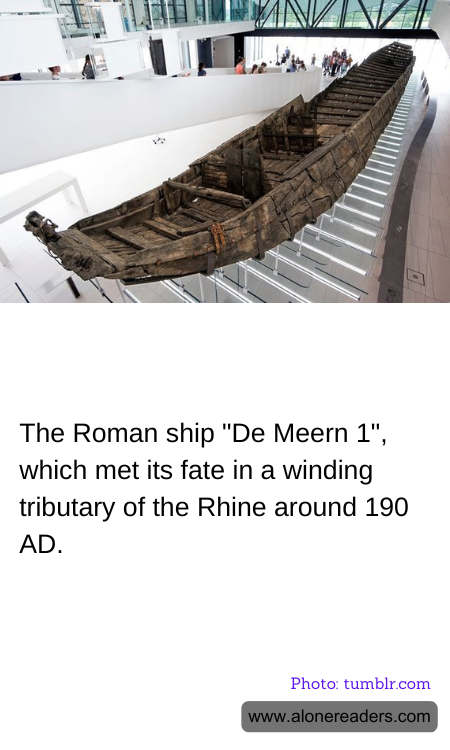
The Roman ship known as "De Meern 1" offers a fascinating glimpse into ancient naval architecture and the broader socioeconomic landscape of Roman Europe. Discovered in 1997 in Utrecht, the Netherlands, during an excavation in the town of De Meern, this vessel has been crucial for understanding both Roman shipbuilding techniques and the dynamics of trade and military logistics during the Roman era.
The ship is dated to around 190 AD, a period when the Roman Empire was at the peak of its territorial expansion and stability under the rule of Emperor Commodus. Made predominantly of oak, "De Meern 1" measures 25 meters in length and 2.55 meters in width. Its design is characteristic of a river barge known as a 'navis lusoria,' a type used predominantly for transport along the shallow inland waterways of the empire. These vessels were vital for not only trade but also for moving troops and supplies, crucial for maintaining the far-flung borders of the Roman Empire.
What makes "De Meern 1" particularly valuable to historians and archaeologists is its state of preservation. The anaerobic conditions in the clay-rich soils of the Netherlands ensured that much of the wooden structure survived nearly two millennia. Such preservation provides unprecedented insights into the construction methods used, including mortise and tenon joints, and a hull built with a combination of planking and framing that showcased advanced Roman engineering skills.
Moreover, the artifacts found aboard the vessel, including pottery, a wooden pulley, leather shoes, and even fabric remnants, offer a wealth of information about daily life in the Roman provinces. These finds suggest that "De Meern 1" was likely used for a combination of commercial transport and military logistics, indicative of the dual-use nature of many Roman ships of this period.
Since its discovery, "De Meern 1" has been carefully studied and conserved. It has significantly contributed to our knowledge of Roman maritime activities in the Rhine delta and the complex network of trade routes that facilitated the Roman Empire's economy. The find is not just a testament to the reach of ancient Rome's influence but also to its sophisticated approach to engineering and maritime logistics. The ongoing analysis and preservation efforts continue to enrich our understanding of Roman technology, economy, and the daily life of its people.