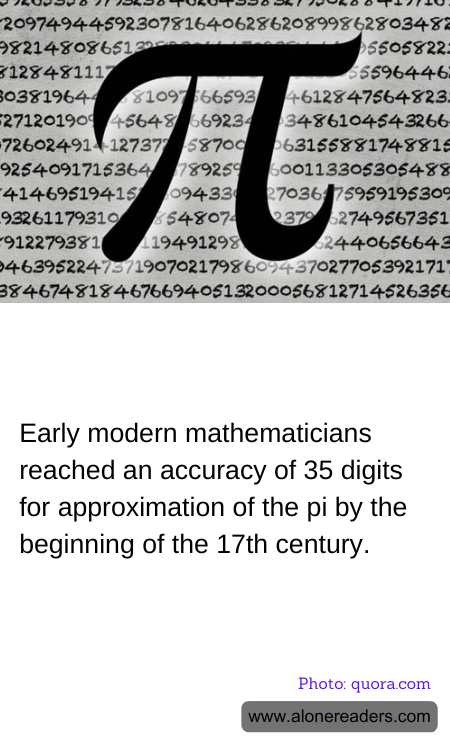
The quest to determine the value of pi (p), the ratio of the circumference of a circle to its diameter, is a fascinating journey through the annals of mathematical history. By the early modern era, specifically the beginning of the 17th century, mathematicians had made substantial advancements in this endeavor, achieving an approximation of pi with remarkable accuracy. Historically, ancient civilizations like the Babylonians and Egyptians initially estimated pi to be about 3.125 and 3.1605 respectively, based on archaeological findings. However, it was during the early modern period that methodologies became significantly more refined.
The significant progress in approximating pi during this period can largely be attributed to the works of mathematicians like Ludolph van Ceulen, who spent much of his life calculating the first 35 digits of pi. Van Ceulen, a German-Dutch mathematician, used the polygonal method proposed by Archimedes, which involved inscribing and circumscribing polygons around a circle and calculating their perimeters. By incrementally increasing the number of sides of the polygon, he was able to reach closer approximations of the circle's circumference, thus refining the value of pi. This laborious and painstaking process culminated in his calculation reaching 35 decimal places, a feat that was monumental at the time and remained unsurpassed for many years.
Van Ceulen's work was so influential that pi was often referred to as "Ludolph’s number" in parts of Europe. Moreover, his achievement reflects not just an individual rigor but also a broader trend of enhanced mathematical techniques, including the use of algebra and trigonometry, which became more sophisticated during the Renaissance as mathematical knowledge was shared widely across Europe.
These developments in the understanding and calculation of pi were not just theoretical exercises. They had practical implications in fields such as astronomy, engineering, and geography, where precise calculations were crucial. The increased accuracy in the value of pi allowed for better calculations of areas and volumes, crucial for constructing buildings, machines, and conducting scientific experiments.
Therefore, the work of early modern mathematicians in pushing the boundaries of pi to 35 digits of accuracy marks a significant milestone in the history of mathematics. It also illustrates a broader shift toward a more empirical and precision-oriented approach in scientific inquiry, setting the stage for future mathematical discoveries and innovations. As such, the journey to understanding pi is a testament to human curiosity and intellectual prowess, reflecting an ever-expanding quest to comprehend the complexities of the world around us.
