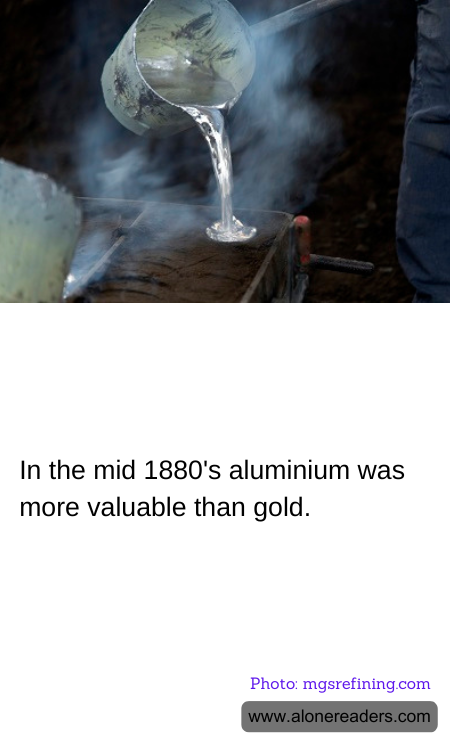
In the mid-1880s, a remarkable situation took place where aluminum was considered more valuable than gold. This pricing anomaly was primarily due to the difficulty associated with extracting aluminum from its ore. Before advancements in technology, the extraction and production of aluminum were extraordinarily challenging and costly. Aluminum is not found freely in nature but is bound in a mineral called bauxite. The metal's extraction process, at the time, involved complex procedures that required a significant amount of energy and resources.
The rarity of aluminum during the 19th century made it more of a status symbol than a functional metal. It was so prized that the French Emperor Napoleon III had cutlery made from aluminum for his most distinguished guests, while others had to make do with mere gold utensils. Even the Washington Monument, capped in 1884, featured a six-pound pyramid of pure aluminum at its apex, highlighting the metal's exalted status.
However, the landscape of aluminum production changed dramatically with the invention of the Hall-Héroult process in 1886. Independently discovered by American Charles Martin Hall and Frenchman Paul Héroult, this method involved dissolving alumina (aluminum oxide) in molten cryolite and reducing it with a powerful electric current to produce pure aluminum. This breakthrough made the extraction process considerably cheaper and more efficient, marking the beginning of widespread aluminum production.
Subsequently, the price of aluminum plummeted as production ramped up rapidly. By the turn of the 20th century, the metal had become accessible and increasingly utilized for a variety of purposes due to its favorable properties such as low density, resistance to corrosion, and high conductivity. Aluminum quickly transitioned from a precious metal to a building block of modern industry, fundamental in the aerospace industry, transportation, packaging, and a host of other applications.
Today, aluminum is one of the most widely used metals in the world, second only to iron in terms of volume. Its journey from a precious metal to a pivotal industrial commodity underscores not only the impact of technological innovation on material availability but also the dynamic nature of economic value and resource utilization over time. The evolution of aluminum's status reflects a common theme in technological and economic history: the transformation of scarcity to abundance can fundamentally change materials' societal and economic roles.
