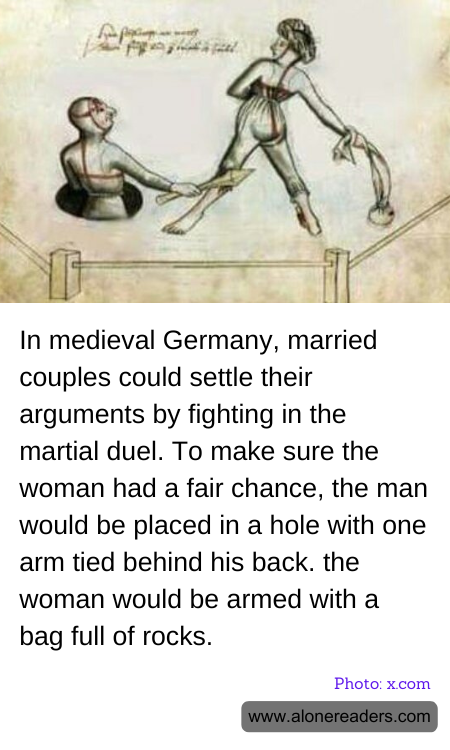
In medieval Germany, an unusual but sanctioned method to resolve disputes between husbands and wives involved a martial duel, reflecting the period's unique legal and social norms. This form of conflict resolution, known as a "combat of honor," was steeped in a mix of legal tradition and societal norms that aimed to ensure fairness when resolving marital disputes, especially given the physical disparities typically between men and women.
The rules of the duel were structured to level the playing field. The man was placed in a waist-deep hole in the ground and had one arm tied behind his back, significantly restricting his mobility and ability to attack. The woman, on the other hand, was given a more advantageous position: she remained free to move around the pit and was armed with a sack filled with rocks. This not only compensated for the physical strength she likely lacked in comparison to her husband but also gave her a strategic advantage.
The choice of armament and the positioning of the combatants were reflective of a deeper legal philosophy of the time which sought to balance the scales of justice, quite literally, by handicapping the stronger party. The duel would continue until a clear winner was determined—either through submission of one party or the physical incapacitation of one of the combatants.
These duels, while seemingly barbaric by modern standards, were conducted under the watchful eyes of local villagers and a presiding judge. They served as both a form of entertainment and a grim reminder of the consequences of marital discord. Additionally, they underscored the legal rights of women to seek reparation and justice within their marriages, which, in many other aspects of life, often saw women underrepresented and undervalued in legal terms.
This method of conflict resolution eventually fell out of favor as legal systems evolved towards more civilized forms of jurisprudence. Nonetheless, it remains a fascinating example of how societies have attempted to balance justice with the cultural and physical realities of their times, reflecting a crude yet earnest attempt to achieve fairness and maintain social order.
