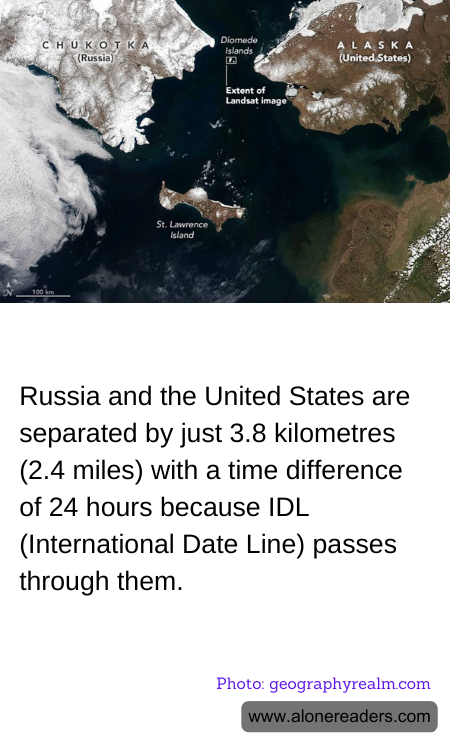
The geographical proximity of Russia and the United States, juxtaposed with the stark time difference between them, provides a fascinating example of how human constructs intersect with the natural world. At their closest point, Russia and the U.S. are separated by merely 3.8 kilometers (2.4 miles) across the Bering Strait, where the Diomede Islands lie — Big Diomede (Russia) and Little Diomede (U.S.). This small physical distance is contrasted sharply by the International Date Line (IDL), which causes a full 24-hour time difference between the two.
The International Date Line serves as an imaginary boundary running from the North Pole to the South Pole, primarily adhering to the 180-degree longitude but deviating in several places to prevent politically associated areas from having split days. This line marks where one day ends and the next begins, twisting through the Pacific Ocean to accommodate international and territorial waters, aligning with political borders and economic considerations where possible.
This phenomenon means that when it is Tuesday on Little Diomede in Alaska, it is already Wednesday on Big Diomede in Russia, despite the short distance that one could theoretically traverse by boat in just a few minutes under favorable weather conditions. This creates not only a temporal disconnect but a mental and cultural bifurcation that underscores the arbitrary nature of time zones and date lines.
This delineation has historical and practical implications, particularly during the Cold War when the two islands represented a stark physical manifestation of the "Ice Curtain" between the Soviet Union and the United States. Today, it serves as a reminder of how human imposition on geographical landscapes can create divisions that are both real and surreal, shaping everything from local interactions to international relations.
The proximity and the time disparity of Russia and the United States at this location encapsulate the complexities of global geography and international policy. It is a clear example of how human-defined systems, such as timekeeping, are embedded into the physical world, affecting how nations and individuals conceptualize and experience their environment.
