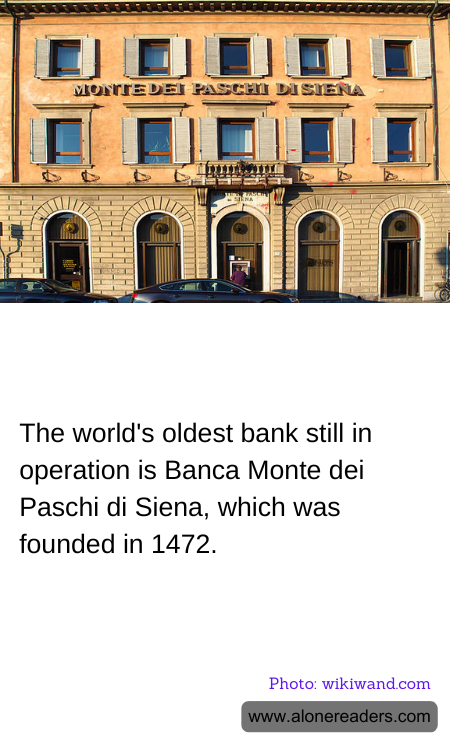
Banca Monte dei Paschi di Siena, founded in 1472, holds a venerable status as the world’s oldest bank still in operation today. Born out of a mount of piety—a charitable institution common in medieval Europe meant to offer low-interest loans to the needy—this historic bank began its life in Siena, Italy, a small city in Tuscany. The original purpose of the bank was to alleviate economic pressures on the city’s working poor, a mission that has evolved considerably over the centuries.
Over the years, Banca Monte dei Paschi di Siena (BMPS) has played a crucial role in the development of Italy's financial landscape. Through strategic expansion and adaptation to the changing economic environment, the bank managed to grow its operations beyond regional borders, establishing a nationwide presence. BMPS has been witness to, and a participant in, key historic and economic events, from the Italian Renaissance, through the industrialization of Europe, and into the complexities of modern global finance.
Despite its age and esteemed legacy, BMPS has not been without its challenges. The 21st century has seen the bank caught in troubling waters, grappling with issues such as financial losses, management crises, and scandal. These problems culminated in a significant state bailout in 2017, which raised questions about the future of this legendary institution.
Nonetheless, the cultural and historical significance of BMPS remains intact. The very architectural structure of its headquarters and many of its branches speaks to a rich Italian heritage, blending with the urban landscape of medieval city centers and reminding passersby of the bank’s ancient origins. Moreover, the bank continues to be a source of pride for Italy, symbolizing endurance and the historic linkage between the financial sector and social welfare initiatives.
As Banca Monte dei Paschi di Siena adapts to the dynamics of modern banking, facing rigorous competition and stringent regulatory environments, its journey from a modest mount of piety to a key player in the Italian banking sector continues to be a subject of study and admiration in both economic and historical circles. The bank's ability to withstand numerous economic cycles over centuries highlights not just resilience but also the critical adaptations necessary to sustain such longevity in the ever-evolving financial world.
