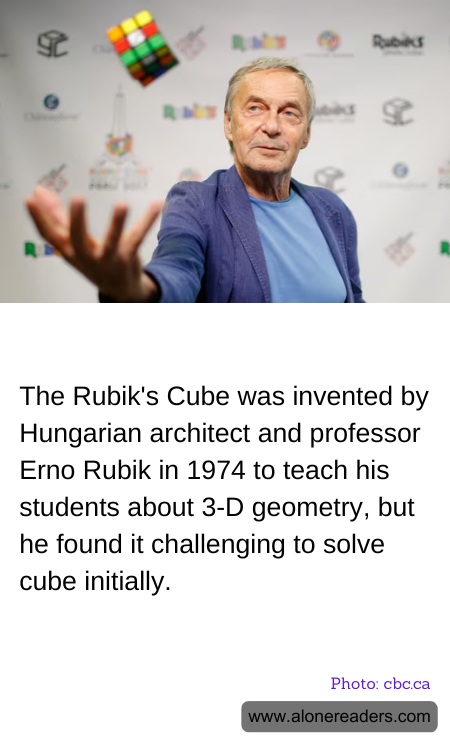
The Rubik’s Cube, that colorful and confounding puzzle that has fascinated millions around the globe, began as a teaching tool devised by Erno Rubik, a Hungarian architect and professor. Invented in 1974, Rubik’s aim was to help his students understand the complexities of three-dimensional geometry. This seemingly simple object, made up of a six-sided, 3x3 cube, each side adorned with a different color, holds an intricate mechanism that allows each face to turn independently.
Initially, Rubik himself couldn’t solve the puzzle he had created, underscoring the challenge it posed. After spending over a month twisting and turning the cube, he finally cracked the puzzle. Inspired by the potential of the Rubik's Cube as both an educational tool and a brain teaser, Rubik decided to share his invention with the world. It was first sold in toy shops in Budapest in 1975, where it was initially called the ‘Magic Cube.’ The puzzle’s name was later changed to ‘Rubik’s Cube’ when it was brought to the global market in 1980, and it quickly became one of the best-selling toys globally.
Solving the Rubik’s Cube requires a deep understanding of the interaction between the pieces as turning one layer can mess up the alignment of another. This requirement for strategic planning and problem-solving is what makes the Rubik's Cube not just a toy, but a tool for enhancing cognitive skills and spatial awareness. The cube's design is a marvel of engineering, as it must allow for extremely fast and smooth turns to enable competitive speedcubing, which has grown into a global phenomenon.
Over the years, the Rubik’s Cube has evolved into various versions, with different sizes and complexities, such as the 4x4 and 5x5 cubes. Each variant presents a new set of challenges and requires different strategies to solve. Despite the myriad of digital distractions available today, the Rubik's Cube remains a beloved puzzle. It continues to inspire both competition and education, encouraging a new generation to think creatively and persevere through challenges.
