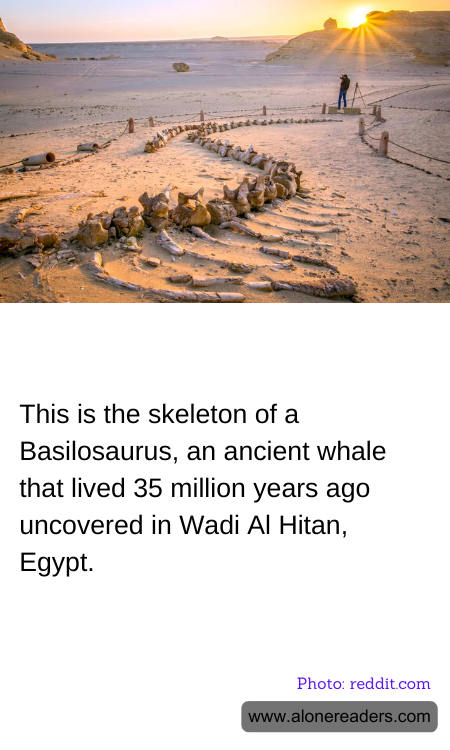
In the sandy expanse of Wadi Al Hitan, Egypt, an exceptional discovery sheds light on the evolution of modern whales through the skeletal remains of the Basilosaurus. This ancient whale, which swam the seas around 35 million years ago during the Eocene epoch, tells a story unlike any other fossil of its kind. Wadi Al Hitan, aptly named the Valley of Whales, serves as a poignant bridge to Earth's ancient aquatic past, revealing numerous specimens of these bygone marine inhabitants that hint at their behavior, diet, and environment.
The Basilosaurus, despite its reptilian-sounding name which means "king lizard," was indeed a fully aquatic mammal. Measuring up to 60 feet in length, Basilosaurus was not only a formidable predator but also a key figure in the story of whale evolution. This creature, characterized by an elongated body and comparatively small limbs, marks a significant divergence from its terrestrial ancestors. Initially mistaken for a dinosaur, further studies have illuminated its true identity as an early whale, showcasing characteristics that link it directly to its modern descendants.
The findings in Wadi Al Hitan have allowed scientists to piece together fascinating aspects of Basilosaurus’ lifestyle. The isotopic analysis of the fossilized remains indicates a diet that included large quantities of fish and squid, placing Basilosaurus at the top of its prehistoric food chain. Additionally, the presence of bite marks on some skeletons and their associated fauna suggest this region was a hub of marine biodiversity, providing a vivid glimpse into an ancient aquatic ecosystem.
The discoveries also enhance understanding of the evolutionary trajectory from land-dwelling creatures to fully marine whales. The anatomical features of Basilosaurus, such as the reduced hind limbs and specialized vertebrae for an aquatic lifestyle, are crucial for understanding how modern whales like the blue whale or the humpback evolved to become fully adapted to life in water. Such transitions mark significant evolutionary shifts, underscored by natural selection and adaptations over millions of years.
The significance of Basilosaurus extends beyond its contribution to paleontology. It also illuminates the broader narrative of life on Earth, the dynamics of prehistoric ecosystems, and the continuous thread of life from one era to another. Wadi Al Hitan continues to be a site of profound scientific interest and understanding, offering more insights into our planet’s biological heritage with each uncovering. As research progresses, the story of Basilosaurus will likely become even more pivotal in the context of evolutionary biology and our understanding of life's incredible adaptability.
