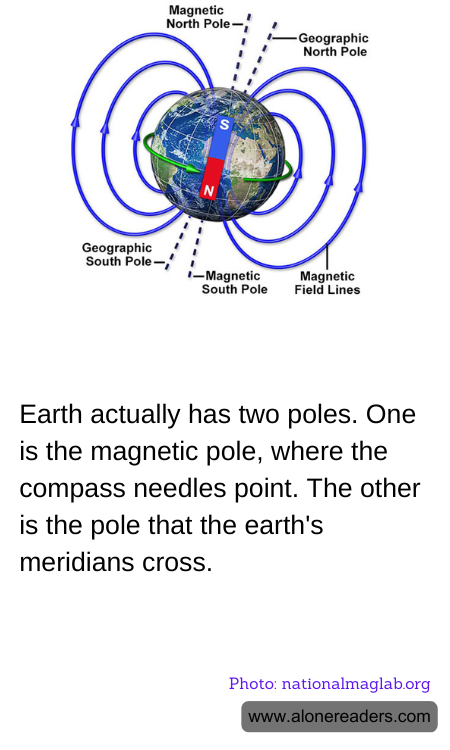
Earth is a planet of dynamic and complex phenomena, one of which is the presence of two distinct types of poles: the geographic poles and the magnetic poles. These poles represent different aspects of the Earth's composition and function, playing crucial roles in navigation, climate, and the study of geophysics.
The geographic poles, consisting of the North Pole and the South Pole, are fixed points where the Earth's axis of rotation intersects its surface. The North Pole is located in the middle of the Arctic Ocean, amidst waters that are almost permanently covered with constantly shifting sea ice. This region is desolate and bitterly cold. Conversely, the South Pole lies on the continent of Antarctica, which is capped by a massive ice sheet. These geographic poles are pivotal in defining latitude — the North Pole sits at 90 degrees North, while the South Pole rests at 90 degrees South.
In contrast, the magnetic poles differ significantly from their geographic counterparts. These are the points on the Earth’s surface where its magnetic field points vertically downwards. These poles are not static and have migrated over time. The movement is due to the Earth's molten outer core, composed mostly of iron and nickel, which moves and flows as the Earth rotates. This fluid motion generates electric currents, which in turn produce the Earth’s magnetic field. The North Magnetic Pole, often confused with the North Pole, has been shifting towards Siberia at a rate of approximately 55 kilometers per year due to changes in the Earth's magnetic field.
The interplay between the geographic and magnetic poles is significant for navigation. Compasses, which are traditionally used to determine direction, point towards the magnetic poles rather than the true geographic poles. This deviation, known as magnetic declination, varies depending on one’s location on the globe and must be accounted for when using a compass for precise navigation.
Moreover, changes in the position of the magnetic poles can influence Earth’s magnetosphere, which protects the planet from the solar wind and cosmic rays. This protective shield is vital for sustaining life, making the study and monitoring of the magnetic poles essential for understanding changes in Earth’s protective environment.
In conclusion, the dual poles of Earth — geographic and magnetic — serve different purposes and are subject to distinct phenomena. Understanding both sets of poles is crucial for navigation, climate science, and geophysical research, revealing the dynamic and interconnected nature of planetary science.
