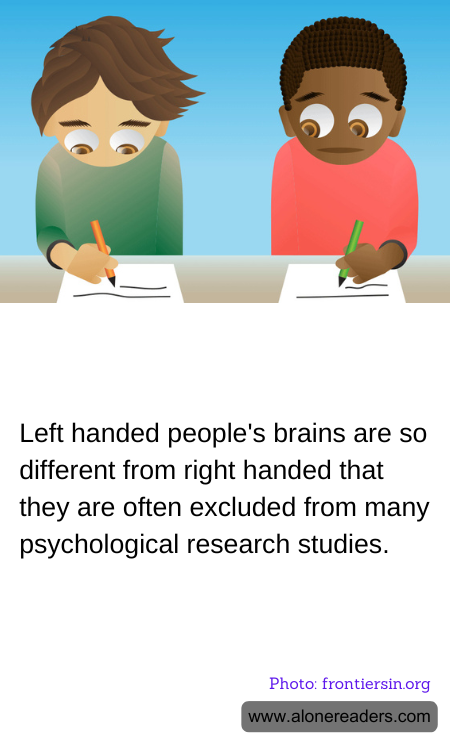
Left-handed individuals, comprising about 10% of the global population, are often conspicuously absent from a broad swath of psychological research studies. This exclusion stems from significant differences in brain structure and function compared to their right-handed counterparts. The brain of a left-handed person is not merely a mirrored reflection of that of a right-handed one; it exhibits distinctive traits, particularly in terms of hemispheric dominance, that can fundamentally alter various cognitive and perceptual processes.
Conventionally, the human brain is divided into two hemispheres: the left, which handles logic, language, and analytical tasks, and the right, which is more concerned with creativity, spatial ability, and intuitive thinking. In right-handed people, the left hemisphere is typically dominant. However, left-handers often show a more ambidextrous brain function, where the right hemisphere may be more active or where responsibilities are more evenly distributed between the two hemispheres. This can affect language processing, memory, and other cognitive functions differently from right-handers.
This divergence in cerebral functioning has led to complications in standardizing psychological research. When studying cognitive processes, brain function, and other psychological parameters, researchers seek controlled, predictable environments and participant profiles to ensure reliable, generalizable data. Including left-handed participants can introduce variables that muddy the clarity of results, particularly in studies heavily reliant on neuroimaging techniques or neurological measurements.
Excluding left-handers can simplify research designs and findings, ensuring more uniform data. However, this practice also ignores potential insights that might be gleaned from the neural and cognitive diversity presented by left-handed individuals. Some studies specifically target left-handed people to explore these unique brain features and their implications for cognition, behavior, and neural processing.
The practice of excluding left-handed participants from many research studies does raise ethical and scientific validity questions. This exclusion may lead to a skewed understanding of brain functions and cognitive processes that are presumed to be universal based on predominantly right-handed data samples. As psychological science advances, there is a push towards more inclusive research practices that consider and embrace neurodiversity, reflecting the full spectrum of human cognitive and neural architecture. Including left-handed individuals more consistently could uncover nuances in data that would otherwise be overlooked, fostering a richer, more comprehensive understanding of the human mind.
