More About This Card
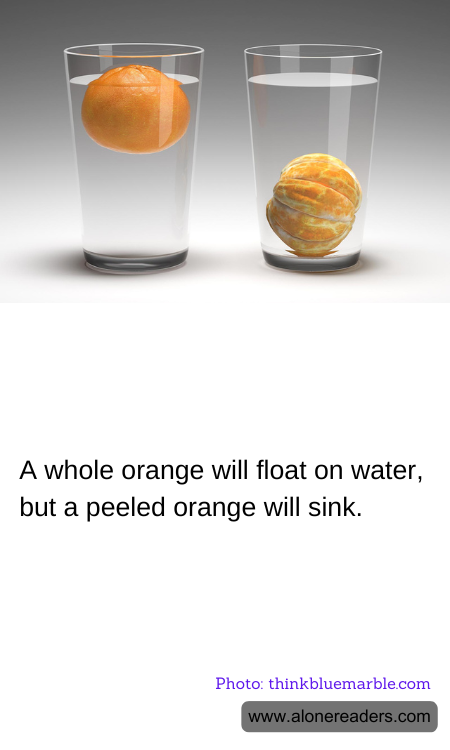
When it comes to floating or sinking in water, whether an orange has its peel on or off makes a significant difference due to the properties of buoyancy and density. An intact orange floats because its peel provides a watertight barrier, containing tiny pockets of air within its structure. These air pockets help increase the orange's overall volume without significantly adding to its mass. As a result, the density of the whole orange (its mass relative to its volume) is less than the density of water, which is approximately 1 gram per cubic centimeter at room temperature.
Water's buoyancy force, which acts against gravity, is able to support the orange, thus making it float. The skin of the orange is not only buoyant but also quite durable and capable of repelling water, further aiding in its ability to float. Apart from this, the natural oils and waxes in the orange peel enhance its water resistance, contributing to the fruit's buoyancy.
However, once the orange is peeled, the situation changes drastically. The removal of the peel eliminates the air pockets and exposes the fruit's flesh, which is denser than the peel. The peeled orange has a higher overall density because the air pockets, which helped to lower its density, are no longer present. When the orange's density becomes greater than that of the surrounding water, it no longer can be supported by the buoyancy force, causing it to sink.
This fascinating behavior can be observed in many other fruits and vegetables and is a fun, simple experiment that illustrates basic principles of physics like buoyancy and density. Understanding why a whole orange floats and a peeled orange sinks can help illuminate broader scientific concepts in a tangible, accessible way, making such experiments valuable educational tools for learners of all ages.