More About This Card
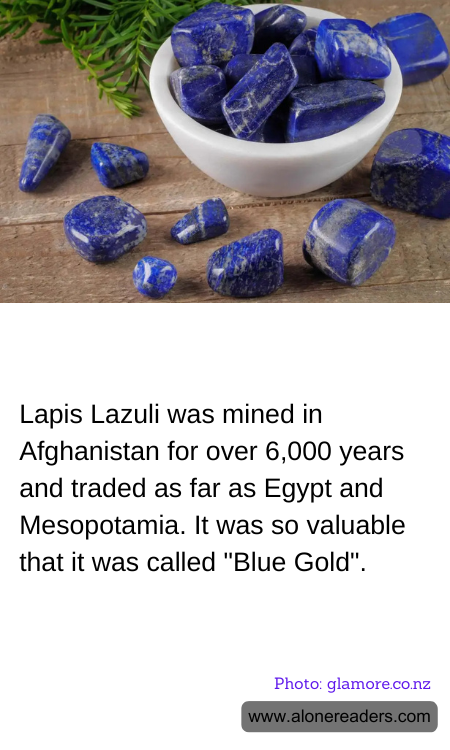
Lapis Lazuli, a semi-precious gemstone that dazzles with its deep blues and golden inclusions, holds a history as rich and colorful as its appearance. Mined in Afghanistan for over 6,000 years, this gem has been a symbol of luxury and status across ancient civilizations. The Sar-e-Sang mine in Afghanistan's remote northeastern province of Badakhshan remains the world’s oldest known commercial gemstone source, operational even today. This locale, seemingly untouched by time, supplies a stone that has captivated human imagination across millennia.
The historical significance of Lapis Lazuli extends far beyond its geologic rarity. By around 4000 BCE, the stone had already become a prized possession in Egypt, used to adorn pharaohs’ tombs and worn as jewelry by the ancient royal families. Perhaps the most famous use of the stone in Egypt is seen in the iconic funerary mask of Tutankhamun, where its deep blue shades are paired exquisitely with gold, symbolizing the night sky studded with stars—an example of the reverence held for its perceived mystical properties. The Egyptians also ground Lapis Lazuli into a fine powder to create the pigment known as ultramarine, which was used to decorate the eyes of their revered gods in their depictions, linking the stone to divine wisdom and insight.
The value of Lapis Lazuli spread beyond Egypt to the empires of Mesopotamia and later across the Roman empire and into the Renaissance. Its color represented royalty and gods, making it highly sought after for amulets and ornaments. It was even traded along the ancient Silk Road, a testament to its desirability that has spanned continents and cultures. The term “Blue Gold” aptly captures its historical significance, as it was not only a commodity of beauty but also of great economic worth.
As the ages passed, the allure of Lapis Lazuli did not wane. Renaissance artists highly prized its powdered form, ultramarine, which was considered more precious than gold. Used by the likes of Michelangelo and Titian, it brought the heavenly blue of their skies and seas to radiant life, carrying forth the legacy of sacredness and splendor into the world of art.
Today, Lapis Lazuli continues to be cherished not just as a gem but as a bearer of history, offering insights into ancient cultures and the trade connections that once linked distant civilizations. Its enduring appeal lies in both its mystique and its stark, captivating beauty—a gemstone truly worthy of the moniker "Blue Gold."