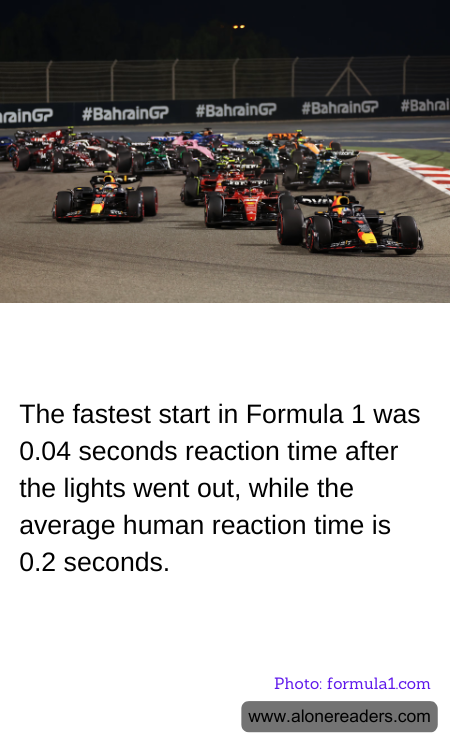
Formula 1, often regarded as the pinnacle of motorsport, not only features cutting-edge technology and some of the most challenging circuits across the globe but also showcases the incredible capabilities of its drivers, particularly in terms of reaction times. A striking example of human speed and precision is epitomized in the record for the fastest start reaction time in Formula 1, which stands at an astounding 0.04 seconds after the lights go out. This feat starkly contrasts with the average human reaction time, which is about 0.2 seconds.
This rapid reaction at F1 starts demands not just innate talent but also intense training and mental acuity. The drivers are reacting not simply on visual cues but also on muscle memory and finely-tuned instincts honed by countless hours of practice and racing experience. The start of a race is critical in Formula 1; a good start can position a driver well and potentially determine the outcome of the race, hence the immense focus on minimizing reaction times.
Comparatively, the average human reaction time of 0.2 seconds seems sluggish. This statistic, generally measured by response to a visual stimulus, is influenced by numerous factors including age, mental state, and physiological conditions. Athletes, particularly those in high-speed sports, typically have faster reaction times than the general population, but even among athletes, Formula 1 drivers are exceptional.
The contrasting figures highlight not only the extreme nature of Formula 1 racing but also the extraordinary capabilities and conditioned reflexes of the drivers. It underscores the extreme environment in which these drivers operate, where even a fraction of a second can be the difference between victory and defeat. F1 drivers continuously train both physically and mentally to improve their reaction times, using simulators and other high-tech aids to gain even the smallest advantage over their competitors.
This exceptional ability to react almost instantaneously is a combination of natural inclination, rigorous training, and advanced technology, all coming together in the intense moments following the start lights going out on the race track. It exemplifies how Formula 1 remains at the forefront of not only automotive engineering but also human performance.
