More About This Card
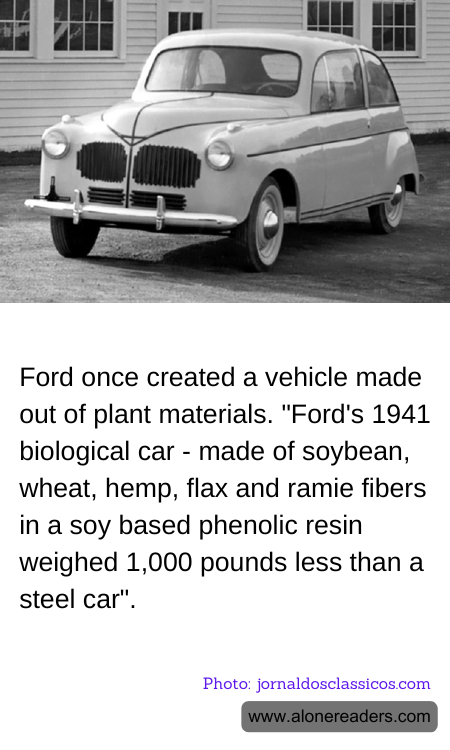
In the 1940s, the automotive industry was marked by an exceptional venture led by none other than Henry Ford, who was then pioneering ways to integrate agricultural products into the manufacturing process. This initiative led to the creation of a groundbreaking vehicle known colloquially as Ford's "biological car." Unveiled in 1941, this vehicle was not just a car but a statement of sustainability and innovation.
Ford's biological car was primarily constructed from a mixture of soybeans, wheat, hemp, flax, and ramie fibers, all bound together with a soy-based phenolic resin. This choice of materials was no accident; it reflected Ford’s vision of supporting agriculture and showcasing the potential of renewable resources in industrial applications. The car's body panels were made from this bio-composite material, which resulted in a vehicle that was about 1,000 pounds lighter than its traditional steel counterparts. This reduction in weight promised not only improved fuel efficiency but also demonstrated the potential for plant-based materials to hold their own in structural applications.
The project mirrored the zeitgeist of its time—a period when resources were heavily guarded due to wartime constraints, and manufacturers were urged to explore alternative materials to conserve metal for military needs. Ford's foresight in the use of agricultural products proved to be forward-thinking, especially considering modern discussions surrounding sustainability and the reduction of carbon footprints in manufacturing sectors.
However, despite its initial promise and the successful creation of a prototype, the soybean car did not progress to mass production. The project was eventually sidelined, overshadowed by the demands and developments of World War II, and the ubiquity and cost-effectiveness of steel post-war helped sideline bio-based materials in manufacturing for decades.
Yet, Ford’s experiment with the soybean car has not been forgotten. It has resurfaced in modern discussions as an early example of biocomposites in automotive design, predating current trends and research into sustainable vehicle production methods. The endeavor highlighted the potentials and challenges of using organic materials in vehicular construction and has inspired ongoing research into eco-friendly materials in various industries, aiming for a more sustainable future that aligns closely with Henry Ford's original vision.