More About This Card
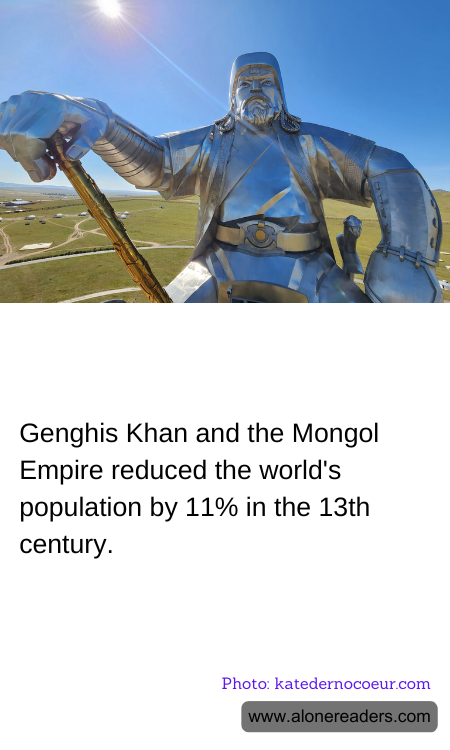
Genghis Khan, one of history's most formidable conquerors, and his Mongol Empire orchestrated invasions and warfare across Eurasia that profoundly impacted the world's demographic landscape. During the 13th century, these conquests led to the reduction of the global population by an estimated 11%, an astounding figure that highlights the brutal efficiency and far-reaching impact of the Mongol expansion.
The Mongol empire, under the leadership of Genghis Khan, expanded out of the Mongolian steppe to cover a vast portion of the known world, stretching from Eastern Europe across Asia to the Sea of Japan. This empire was the largest contiguous land empire in history. The Mongols were not only remarkable for their military strategies and horseback riding skills but also for the sheer devastation they wrought on the territories they invaded. They were known to depopulate entire regions, destroy fields, irrigation systems, and cities, which along with widespread slaughter, led to famine and disease.
Cities from Beijing to Baghdad were razed, and historians estimate that millions of people were killed in what can be considered some of the most lethal military campaigns in human history. For instance, in the year 1220 alone, in Nishapur, one of the largest cities in northeastern Iran, it is recorded that the Mongols killed over a million people. This pattern was replicated in numerous other cities across the empire.
The demographic changes brought forth by the Mongol invasions had long-lasting effects on the world’s population. Entire cultures were shifted or erased, and the genetic makeup of populations across Asia and Europe was permanently altered. Moreover, the scale of destruction of agricultural land led to widespread famine, further reducing the population.
In addition to their violent conquests, the Mongols also established trade routes and systems of communication between the East and West, known as the Silk Road. This facilitated the exchange of goods, ideas, and technologies, thereby connecting disparate parts of the world in a new way. Ironically, this increased connectivity also likely contributed to the spread of diseases, most notably the Black Death, which would later devastate Europe, itself contributing significantly to a decrease in the world's population.
In conclusion, the legacy of Genghis Khan and the Mongol Empire is dual-edged. While they were architects of destruction on an unprecedented scale, leading to a significant reduction in the world's population, they also laid the groundwork for increased global interaction. This complex historical figure and the empire he forged left indelible marks on the course of human history, both tragic and transformative.