More About This Card
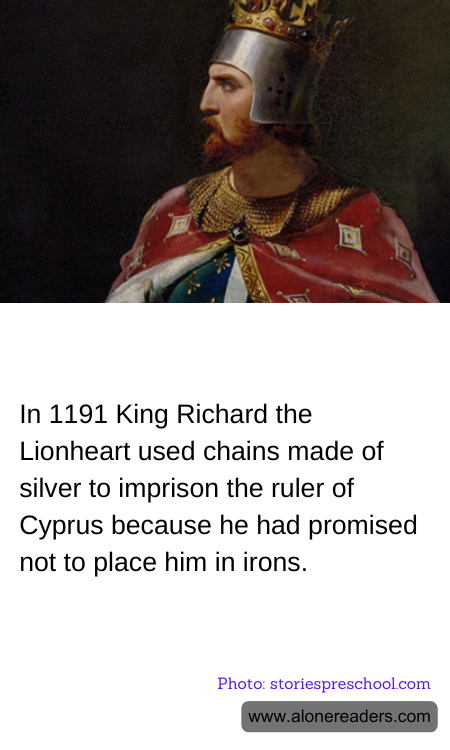
In an intriguing episode from the annals of medieval history, King Richard I of England, commonly known as Richard the Lionheart, showcased his cunning and strategic thinking during the Third Crusade. In 1191, as he led his forces towards the Holy Land, Richard made a consequential stop at Cyprus. This island, strategically vital due to its location, was then under the control of Isaac Komnenos, a self-proclaimed ruler who had angered Richard by mistreating shipwrecked Crusader soldiers.
Richard's response to this provocation was swift and decisive. He invaded Cyprus, capturing Isaac Komnenos. Legend has it that Isaac, probably aware of Richard’s reputation for both honor and ruthlessness, extracted a promise from the English king that he would not be put in iron chains. Richard, adhering to the letter but not the spirit of this vow, ordered that Isaac be bound in chains of silver instead. This act was not just a demonstration of Richard's clever manipulation of words; it also reflected the medieval mindset where the letter of an oath was sacrosanct, yet could be circumnavigated by creative interpretations.
The use of silver chains rather than iron has multiple layers of significance. Symbolically, silver chains could be seen as a mark of respect or a less harsh treatment accorded to a fellow noble, albeit a defeated one. Pragmatically, it demonstrated Richard’s vast resourcefulness and his flair for psychological warfare, implicitly reminding all who heard of the story that he was a monarch who could afford to imprison a ruler in precious metal.
Following Isaac's capture and the subsequent subjugation of Cyprus, Richard sold the island to the Knights Templar. This maneuver helped finance his Crusade in the Holy Land and secured a crucial resupply base for the Christian forces. The incident thus not only highlighted Richard the Lionheart’s strategic acumen but also underscored his role in the complex geopolitical and military engagements of the Crusades. This blend of chivalry, strategy, and ruthless efficiency exemplifies why Richard I remains one of the most legendary figures in medieval European history.