More About This Card
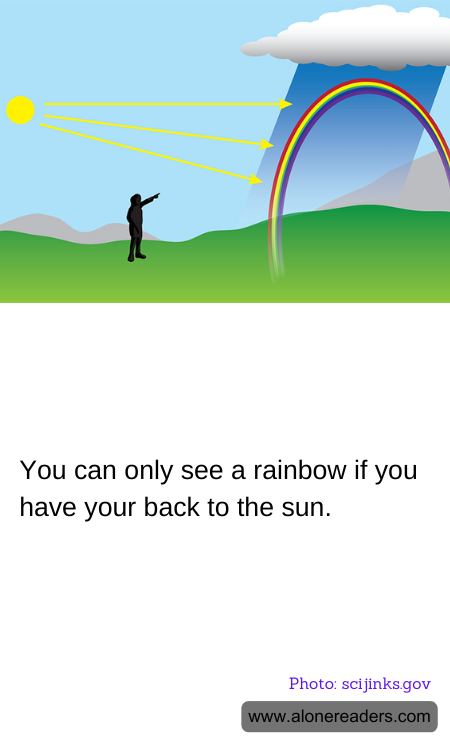
Rainbows, one of nature's most enchanting optical phenomena, manifest when specific atmospheric conditions align, offering a vivid spectacle of light and color. Central to observing a rainbow is the position of the sun relative to the observer. Indeed, a key requirement is that the observer must have their back to the sun. This positioning is crucial because rainbows form when sunlight is refracted, or bent, as it passes through water droplets in the atmosphere, typically during or just following a rain shower.
When sunlight encounters these droplets, it is first refracted upon entering the droplet, then reflected off the inside surface of the droplet, and refracted once again as it exits the droplet. This process disperses the light into its constituent spectral colors - red, orange, yellow, green, blue, indigo, and violet. The light rays are reflected back at particular angles that depend on the size of the droplets and the wavelengths of the colors. The angle of minimum deviation, at about 42 degrees from the direction of the incoming sunlight for the red light (with other colors fanning out at slightly different angles), is what typically forms the primary rainbow.
As a result, for an observer to see a rainbow, the sun must be low in the sky, ideally no more than 42 degrees above the horizon, and the sky must contain water droplets with the observer located between the sun and the droplets. This configuration places the observer’s back to the sun and their face towards the arc of the rainbow, ideally against a backdrop of darker clouds which serve to enhance the visibility and vibrancy of the colors.
This directional aspect of rainbow viewing explains why rainbows are often observed in the early morning or late afternoon, particularly after a passing storm, when the sun is suitably positioned in relation to the observer and residual raindrops still linger in the atmosphere. It also underscores why rainbows cannot be observed when the sun is high in the sky; the necessary angular arrangement between the sun, the observer, and the water droplets cannot be achieved.
Understanding the interplay between light, observer position, and atmospheric conditions not only enriches the appreciation of the aesthetic beauty of rainbows but also deepens the insight into the physics behind such meteorological phenomena. Observing a rainbow through this scientific lens transforms a simple arc of colors into a fascinating synthesis of optics and environmental conditions, woven together to produce a moment of transient beauty in the sky.