More About This Card
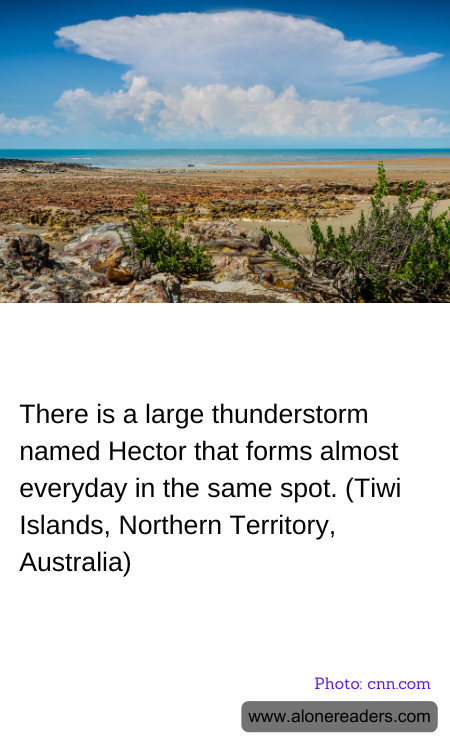
Situated over the Tiwi Islands in Northern Australia, a remarkable meteorological phenomenon occurs with such regularity that it has been affectionately named "Hector the Convector." This thunderstorm is noteworthy not just for its intensity and size, but also because it forms nearly every day during the late spring and early summer months. Hector is one of the world's most consistent thunderstorms, appearing so reliably that it serves as a natural timekeeper for local residents, who can almost set their watches by its daily formation.
The conditions that lead to the creation of Hector are unique to the geographical and climatic attributes of the Tiwi Islands, located to the north of Darwin in the Northern Territory. The islands sit at a point where sea breezes from surrounding waters converge. During the warm months, the intense solar heating of the land creates strong updrafts of warm, moist air. These updrafts meet with cooler air above, leading to the condensation and formation of storm clouds. The converging sea breezes help to further drive these clouds up into towering cumulonimbus formations, typically peaking in the early to mid-afternoon.
As Hector develops, it is not only a spectacle of nature but also a focus for scientific research. Meteorologists and atmospheric scientists study its formation to better understand weather patterns and the behavior of storm systems. Such consistent storms offer valuable data points to examine the dynamics of severe weather, aiding in the improvement of predictive meteorological models.
Apart from its scientific interest, Hector has become a bit of a local celebrity and a draw for tourists, particularly storm chasers and weather enthusiasts eager to witness its majesty. The towering anvil of the storm, often reaches heights of over 20 kilometers, making it visible from miles away, well before the storm reaches its peak intensity.
However, like all thunderstorms, Hector can be dangerous. It often features lightning, heavy rains, and strong winds, posing risks to the local community and to visitors. Despite this, for the people of the Tiwi Islands and nearby Darwin, Hector has woven itself into the fabric of local life, marking the rhythm of daily activities and season changes with its predictable yet awe-inspiring presence.