More About This Card
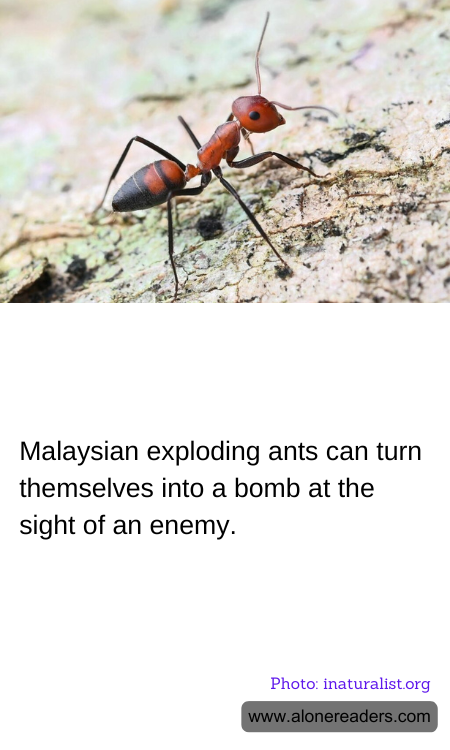
In the dense rainforests of Southeast Asia, a unique species of ant has evolved a dramatic and deadly method of defense. Known as Malaysian exploding ants, or Colobopsis explodens, these insects have the astonishing ability to sacrifice themselves to protect their colony. When confronted with threats, particularly from larger predators, these ants can intentionally rupture their body walls, releasing a sticky, toxic substance that can immobilize or kill attackers.
This form of altruistic self-sacrifice is known as autothysis, a Greek term which translates to “self-splitting”. It is a strategy employed by only a few species in the animal kingdom, predominantly among social insects like ants and termites. The exploding ants possess large glands full of the toxic substance, which are located throughout their bodies. When threatened, the ants will contract their abdominal muscles forcefully, causing the glands to burst and spray the secretion in a small radius around them.
The secretion serves multiple purposes. It is extremely sticky, capable of entangling small predators and halting their advance. More crucially, it contains a potent chemical cocktail that can fatally injure or deter further attack from the predator, giving other ants in the colony time to escape or mount a coordinated defense. This self-sacrifice by the exploding ant effectively turns it into a kamikaze, using its own body as a chemical weapon.
The behavior is primarily observed in worker ants, who do not reproduce and whose primary role is the protection and maintenance of the colony. This makes their sacrifice particularly beneficial from an evolutionary perspective, as it helps ensure the survival and success of their genetically related nestmates, which includes the reproductive queen and her offspring.
The discovery and study of Malaysian exploding ants have provided fascinating insights into the complex social structures and defensive strategies of ants. It underscores the incredible adaptability and survival mechanisms evolved by species over millennia, particularly in the competitive and predator-rich environments of rainforests. Nevertheless, while their behavior may seem extreme, it highlights the intricate and often drastic lengths to which nature will go to ensure the survival of a species.