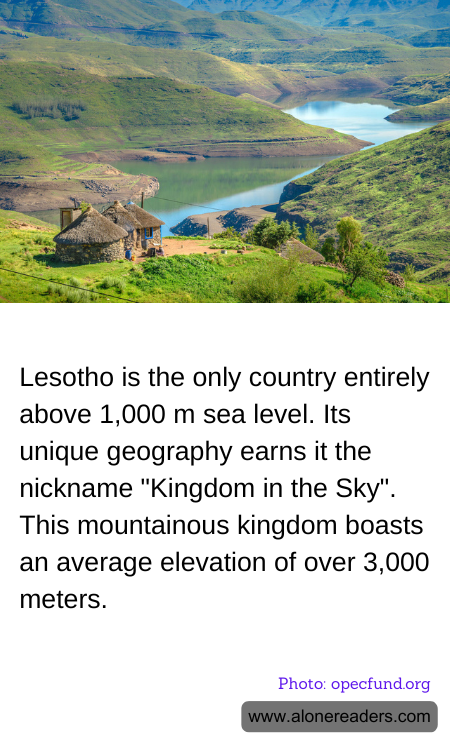
Lesotho, famously dubbed the "Kingdom in the Sky," holds the distinct accolade of being the only country in the world that lies entirely above 1,000 meters in elevation. This unique geographical feature has a profound impact on its climate, culture, and economy. Nestled within the highlands of southern Africa and entirely landlocked by South Africa, it is a place where rugged landscapes and breathtaking vistas are commonplace. The terrain is predominantly mountainous, with peaks soaring over 3,000 meters, creating a stunning but challenging environment for both residents and visitors.
The high altitude results in a cooler climate for Lesotho compared to its neighboring regions, with snowfall occurring in the winter months – a rarity in the predominantly warm southern Africa. This climatic anomaly not only influences the daily lives of the Basotho people but also shapes their cultural identity and practices. Traditional woolen garments, such as the Basotho blanket and the mokorotlo, a conical hat, are both cultural symbols and practical responses to the chilly highland weather.
Economically, the altitude and terrain offer both opportunities and obstacles. Agriculture, while still a staple of its economy, is limited to small patches of arable land, and the main crops grown are maize and wheat supplemented by livestock farming. Conversely, the mountains are a source of water and have helped Lesotho become a significant exporter of water to South Africa, through the Lesotho Highlands Water Project, which harnesses the natural highland springs and snow melt.
The dramatic landscape not only supports biodiversity but also makes Lesotho a unique destination for tourism. Activities like pony trekking and hiking attract adventure tourists looking to explore its untouched natural beauty. The Sehlabathebe National Park, a UNESCO World Heritage site, exemplifies Lesotho’s commitment to preserving its natural heritage. Here, visitors can witness a wide array of flora and fauna, some endemic to the region, set against the backdrop of ancient rock art made by the San people thousands of years ago.
Despite its beauty and natural resources, Lesotho faces significant development challenges exacerbated by its geographical isolation and topography. Infrastructure development is costly and complicated by the terrain, limiting access to many areas. Moreover, the highland's harsh conditions can isolate communities, affecting their access to services like healthcare and education.
In summary, Lesotho's distinction as a nation soaring above 1,000 meters offers unique advantages and distinct challenges. Its cultural identity and economic activities are deeply intertwined with its mountainous landscape, defining life in this elevated enclave. As it continues to develop, balancing modernization with the preservation of its environmental and cultural heritage remains a priority.
