More About This Card
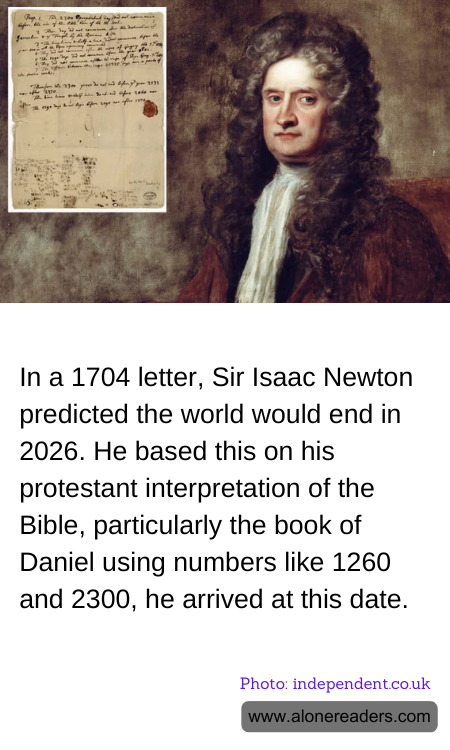
Sir Isaac Newton, more commonly known for his pioneering work in physics and mathematics, also had a profound interest in biblical prophecy and alchemy. His prediction about the end of the world, pointing to the year 2026, is a lesser-known aspect of his intellectual legacy. In a letter penned in 1704, Newton extrapolated this conclusion from his deep, albeit non-mainstream, religious studies.
Newton's prediction was rooted in the Book of Daniel, which he, like many scholars of his era, interpreted through his Protestant lens. The numbers 1260 and 2300 mentioned in the biblical text were key to his calculation. These numbers appear in prophetic contexts in the Bible and have often been the subject of various interpretative attempts over centuries. Newton understood these figures as indicative of a timeline that culminates in the world's end as prophesied in Christian eschatology.
Despite his genius in scientific realms, Newton's theological ponderings reflect the typical 17th-century European attempt to reconcile religious beliefs with emerging scientific understandings. It's important to note that these predictions were formulated in a completely different context from his scientific work and, unlike his scientific theories, are not supported by empirical evidence. Rather, they demonstrate his interest in the hidden meanings he believed were encrypted within religious texts.
Newton’s eschatological views offer a fascinating glimpse into the holistic nature of his intellectual pursuits but should be read with an understanding of their speculative and purely interpretative nature. They suggest a part of his intellectual life deeply embedded in the religious and mystical beliefs of his time, a far cry from the empirical rigor that characterizes his contributions to physics and mathematics. While interesting from a historical and biographical perspective, Newton's prediction about the end of the world in 2026 remains a curiosity rather than a scientifically based forecast.