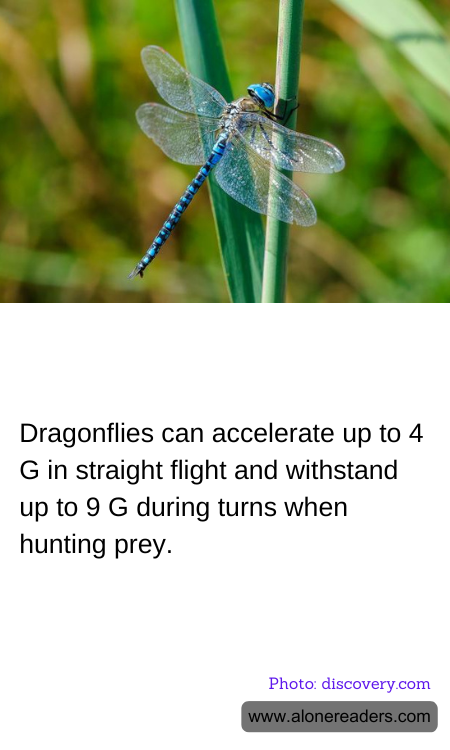
Dragonflies are among the most agile fliers in the insect world, capable of astonishing feats of speed and precision. Remarkably, these insects can accelerate at up to 4 Gs in straight flight. This level of acceleration is impressive, particularly considering that it is a rate comparable to what some high-performance sports cars can achieve. This rapid acceleration enables dragonflies to dart away from predators swiftly and to catch prey effectively.
What is even more remarkable is their ability to withstand up to 9 Gs during sharp turns. This ability is crucial during their aerial hunting expeditions, allowing them to make lightning-fast changes in direction to outmaneuver their prey or escape threats. This degree of maneuverability is not just a function of raw power, but also of their expertly designed wings and extraordinarily coordinated wing muscles, which allow them to rotate and pivot with incredible precision.
The dragonfly's body is also exceptionally suited to its fast-paced, acrobatic flying style. Its long, slender body and two sets of wings help maintain stability and control at high speeds and during sudden directional changes. Moreover, their wings work independently of each other, which not only gives them the ability to hover and fly backward but to change direction almost instantaneously.
The dragonfly's impressive flight capabilities are also complemented by its acute vision. With large multifaceted eyes that give almost 360-degree vision, dragonflies can spot movement of other insects and assess depth and distance as they maneuver through their environment. This exceptional vision supports their agile flying skills, making them formidable hunters capable of calculating precise distances and angles to intercept moving prey.
Understanding the mechanics behind the dragonfly's flight can provide insights into biomimicry for advanced technological applications, including improving the maneuverability and speed of drones or other flying robots. Their natural abilities showcase an evolutionary perfection in both structure and function, offering valuable lessons for both nature enthusiasts and technological innovators.
