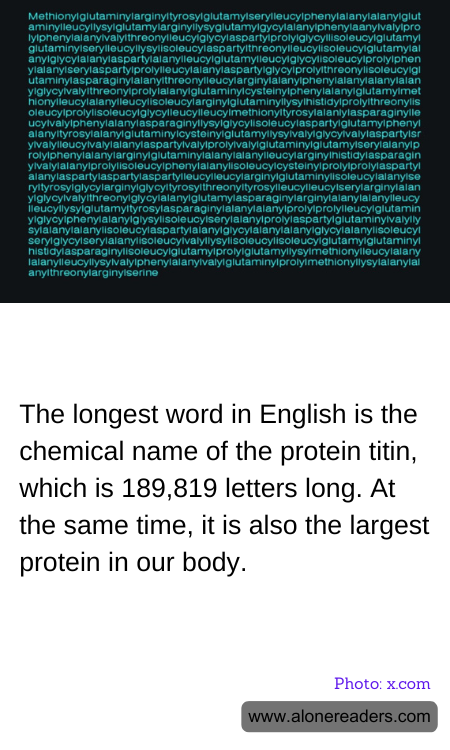
The longest word in the English language is the chemical name for titin, a giant protein that plays a critical role in the passive elasticity and active contraction of muscle. This mammoth word, consisting of 189,819 letters, dwarfs every other entry in the linguistic lexicon due to its extensive description of the chemical composition of this protein. Such lengthiness results from the conventions in biochemical nomenclature which string together the names of the amino acids that compose the protein in the order in which they occur.
Titin, not only famed for its lengthy name, is also the largest known protein in the human body. It spans half the length of a muscle sarcomere, stretching approximately from the Z line to the M line in the muscle fiber. Its size and structure are instrumental in providing structural integrity and elasticity to muscles. This enables titin to act like a spring which helps muscles return to their resting state after being stretched or contracted.
The importance of titin extends beyond its physical properties. It plays a crucial role in muscle function and biomechanics, including the regulation of muscle elasticity, signal transduction, and the assembly of myofibrils, making it a vital element in muscle efficiency and mechanical stability. Mutations in the gene coding for titin are linked to certain forms of cardiomyopathy and muscular dystrophy, underscoring its critical role in muscle health and disease.
Given its giant stature within both the lexicon of English words and the biomolecular structure of the human body, titin is a fascinating subject of study for researchers. It highlights the intersection of language, biology, and medicine, providing not just a curiosity in terms of its prodigious name but also a vital insight into muscular architecture and pathology.
