More About This Card
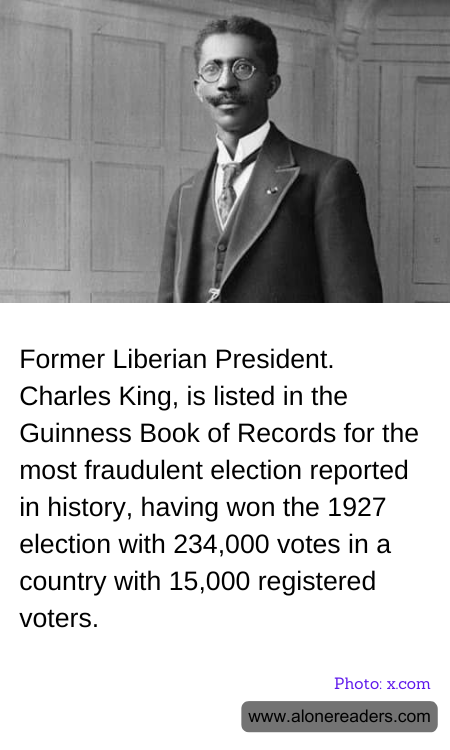
Elections are fundamental components of democratic governance, where citizens ideally have the opportunity to select their leaders in free and fair manners. However, history has repeatedly shown that this is not always the case across various global jurisdictions. One notably egregious example is the 1927 presidential election in Liberia involving former President Charles King. This election is often highlighted as one of the most blatant instances of electoral fraud in recorded history.
Charles King, who served as the President of Liberia from 1920 to 1930, was accused of gross electoral misconduct during the 1927 elections in which he sought re-election. The extent of fraud in this election was so significant that it earned a place in the Guinness Book of Records. The official results declared Charles King the winner with a staggering 234,000 votes, a number that was patently absurd considering there were only about 15,000 registered voters at the time. This discrepancy indicated that the actual vote count was inflated by more than 15 times the number of registered voters, an achievement that pointed to an obvious manipulation of the electoral process.
The 1927 election in Liberia not only cast a long shadow over King’s presidency but also over the democratic integrity of the country as a whole. Such a blatant disregard for the principles of democratic elections undermined public confidence in the electoral process, and by extension, the legitimacy of the administration itself. The incident demonstrated how electoral fraud could severely affect governance and political stability.
The ramifications of this historical event are still discussed in studies on electoral integrity and political history, serving as a cautionary tale of the potential for abuses in electoral systems. It underscores the importance of transparency, accountability, and strong democratic institutions to prevent such occurrences in the future, ensuring that the leadership truly reflects the will of the people.