More About This Card
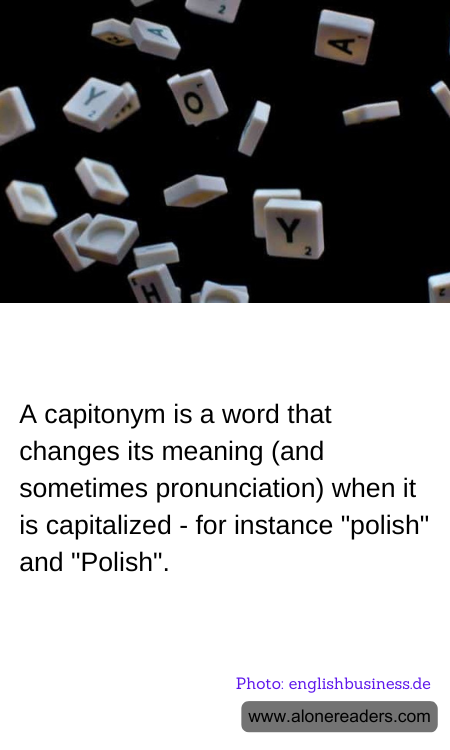
Capitonyms are a fascinating feature of the English language where a word that is spelled the same has different meanings and sometimes different pronunciations depending on whether the first letter is capitalized. This characteristic of English can lead to intriguing confusions and amusing misunderstandings, making capitonyms particularly interesting to linguists and language enthusiasts.
One classic example of a capitonym is the pair "polish" and "Polish." When written with a lowercase 'p', "polish" refers to a substance used to give things a smooth and shiny surface, or the action of making something smooth and shiny. However, when capitalized, "Polish" relates to anything pertaining to Poland, such as the Polish language or the Polish people. The pronunciation shifts slightly between these two forms. The word 'polish' (lowercase) is typically pronounced with a soft 's', whereas 'Polish' (uppercase) is pronounced with a sharper 'sh' sound.
Another example is "march" versus "March." As a lowercase word, "march" is a verb meaning to walk in a firm, regular manner or a noun indicating a formal, rhythmic way to move, like what soldiers do. However, with a capital 'M', "March" refers to the third month of the year in the Gregorian calendar, bearing no relation to walking or moving rhythmically.
The existence of capitonyms highlights the importance of capitalization in English, which can signify the difference between a common noun and a proper noun or adjective. For instance, "herb" refers generally to any plant used for flavoring, food, medicine, or perfume, but "Herb" is a nickname for Herbert, a person's name. Similarly, "job" refers to employment, but "Job" can refer to a person's name, most commonly recognized as a character from the Bible.
Understanding capitonyms is crucial for effective communication in English, as misunderstanding can occur if one fails to capitalize appropriately or recognize the context in which the word is used. For learners and non-native speakers, capitonyms can present an added layer of complexity to mastering the language. They encapsulate the quirky nature of English, where even slight changes in capitalization can lead to entirely different meanings and interpretations.