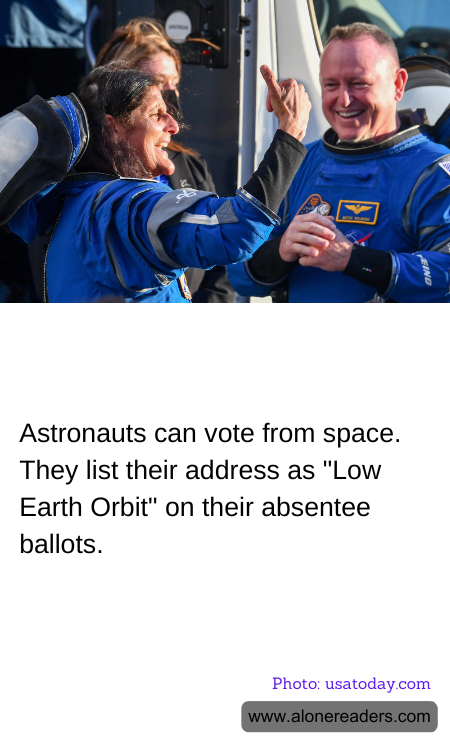
Voting from space has become one of the modern marvels of democracy, allowing astronauts to participate in elections while orbiting the Earth. This process ensures that those on missions, who can be away from the planet for six months or even longer, do not miss out on their civic duties. The voting system for astronauts cleverly combines technology with legal foresight, ensuring they remain active participants in decisive national matters.
The procedure for space voting was established in the 1990s, after a realization that astronauts could be on a mission during election cycles. This led to the passing of a bill in Texas (home to Houston's Johnson Space Center where most U.S. astronauts are based and from where U.S. human spaceflight missions are controlled) which allows American astronauts - who are mostly registered in Texas - to vote electronically from space. To make this possible, their ballot is securely sent via an electronic method from the county clerk to NASA’s Johnson Space Center. From there, it is transmitted to the space station where the astronaut can cast their vote in secrecy and send it back the same way. The completed ballot makes its way back to Earth to be counted along with other absentee ballots.
On their absentee ballot forms, astronauts list their address as “Low Earth Orbit,” reflecting their unique, off-planet residence. This underlines the unique blend of technology, law, and commitment to democracy that enables this process. Fulfilling this civic duty is not just symbolic; it highlights the extent to which institutions have gone to uphold the rights and privileges of every citizen, no matter where they are in the universe.
This capability symbolizes a significant achievement in the field of space exploration and governance, reflecting a commitment to inclusivity and adaptability within the democratic process. It underscores that participation in the fundamental process of election is not constrained by Earthly boundaries, and every vote counts equally, whether cast from a polling station on Earth or from the solitude of space.
