More About This Card
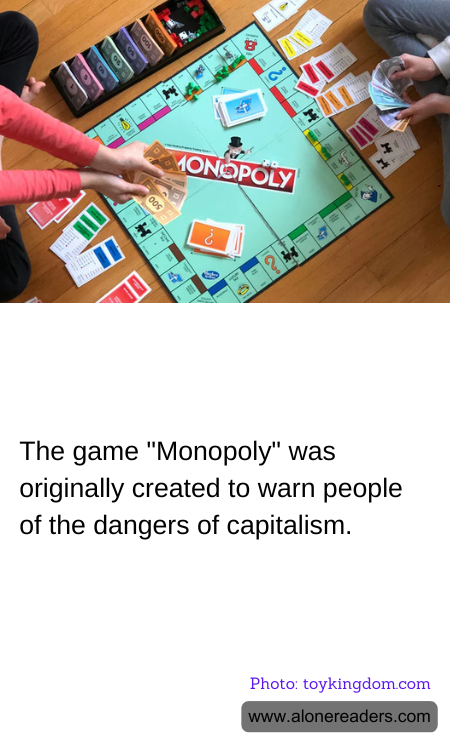
One of the world's most iconic board games, Monopoly, was originally designed with a much more serious purpose than simply entertaining families on game night. Its inception dates back to the early 20th century when Elizabeth Magie, a writer, inventor, and feminist, created The Landlord’s Game, the precursor to Monopoly, in 1903. Magie’s intention was to illustrate the potential dangers and pitfalls of unchecked capitalism and land monopolism.
The Landlord's Game featured two sets of rules: an anti-monopolist set in which all were rewarded when wealth was created, and a monopolist set in which the goal was to create monopolies and crush opponents, closely mirroring the ultimate gameplay of Monopoly as we know it today. Her philosophical and political leanings towards the teachings of Henry George, particularly his advocacy for the “Single Tax” concept of economics, heavily influenced Magie's game design. She hoped her game would make apparent the inefficiencies and injustices of land grabbing and the monopolistic accumulation of wealth.
By the 1930s, during the depths of the Great Depression, a man named Charles Darrow rediscovered Magie’s patented but largely forgotten game. He adapted and commercialized it under the name Monopoly, subsequently selling it to the Parker Brothers. Darrow has often been credited with the game’s creation, overshadowing Magie’s critical role and original intent. The irony lies in the fact that Darrow benefitted from creating a monopoly of his own on the game's sales, which became and remains a symbol of capitalist success. The game dropped its educational dual-rule structure and embraced the winner-takes-all gameplay that made it famous worldwide.
Today, Monopoly is known more for its ability to entertain and occasionally frustrate with its ruthless competitive streak rather than its origins as a cautionary tale about capitalism’s darker tendencies. It has been translated into numerous languages and sells millions of units every year, spanning various editions and themes. Despite its transformation from a teaching tool into a mainstream entertainment product, the hints of its origins can still be seen in its mechanics of monopolization and property speculation, serving, perhaps unintentionally, as a rudimentary lesson in the dynamics of capitalism, albeit in a much less explicitly educational format than Magie originally intended. Monopoly’s history reminds us of the game's deep-rooted connection to economic principles and the impact of intellectual property in the capitalist system.