More About This Card
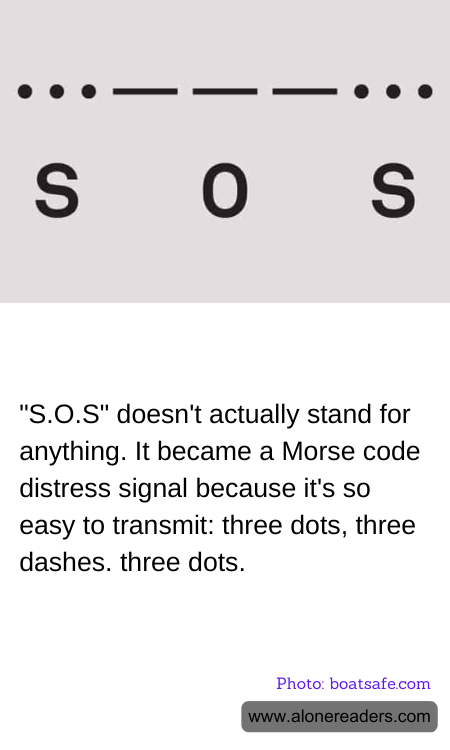
The Morse code signal "S.O.S" is universally recognized as a call for help, but contrary to popular belief, the letters "S.O.S" don’t stand for anything like “Save Our Souls” or “Save Our Ship,” as often misinterpreted. The signal was chosen purely for its simplicity and effectiveness in Morse code communication: three dots, three dashes, and three dots (· · · — — — · · ·). This sequence is distinctly recognizable and less likely to be misinterpreted due to its clarity and brevity, making it highly effective in emergency situations.
The origin of "S.O.S" as a distress signal dates back to the early 20th century. In 1906, during the International Wireless Telegraph Convention in Berlin, the need for a standardized distress signal was recognized due to the increasing reliance on wireless telegraphy for maritime communication. The signal was officially introduced on July 1, 1908, by the German government, which proposed the use of "S.O.S" because it could be easily remembered and transmitted. This signal replaced a variety of more cumbersome distress signals previously used, standardizing a crucial aspect of emergency communications.
"S.O.S" was quickly adopted globally due to its effectiveness. Notably, it was used during the sinking of the Titanic in 1912, helping to establish it firmly in the public consciousness. Although today technological advancements have led to the development of more sophisticated systems for emergency communication, such as the Global Maritime Distress and Safety System, the "S.O.S" signal remains a powerful symbol of aid and an important part of historical and cultural reference in the context of emergency communication. Its simplicity and the dramatic context of its use continue to capture public imagination, underscoring the fundamental human requirement for safety and rapid assistance in times of dire need.