More About This Card
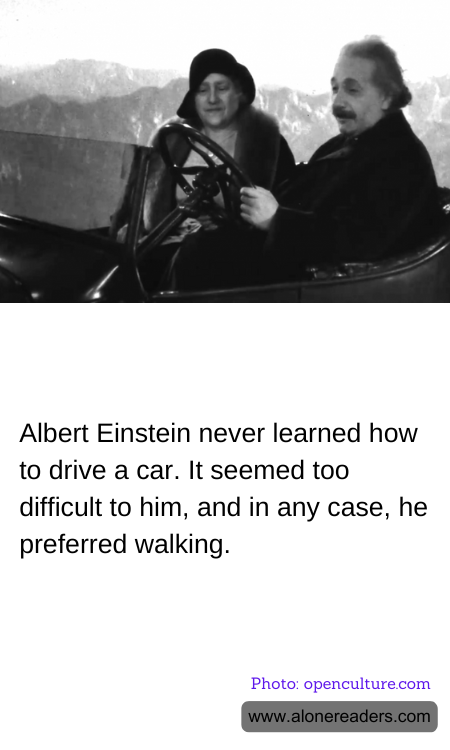
Albert Einstein, the legendary physicist known for his theories of relativity, never learned how to drive a car. Despite his profound understanding of the complexities of the universe, he found the prospect of maneuvering a vehicle too challenging. His decision not to drive, however, was rooted not just in difficulty but perhaps also in personal preference—for Einstein, walking was more than just a way to get around; it was a time for reflection and creativity.
Walking for Einstein was akin to meditation, a quiet time during which he often found the mental space to unravel the knotty problems of physics that occupied his mind. These strolls became an integral part of his daily routine, regardless of the weather or his location. He was known for taking long walks at Princeton while he was a professor there, often accompanied by fellow scholars, with whom he shared and debated ideas.
This preference for walking over driving aligns with Einstein's overall lifestyle, which was marked by simplicity and a lack of materialism. He was famously indifferent to fame and fortune, prioritizing his intellectual pursuits and humanitarian ideals above all else. By avoiding driving, Einstein also avoided the distractions and responsibilities that come with vehicle maintenance, insurance, and navigation, thus freeing up more time and mental energy for his scientific work and his musings.
In reflecting on the wide array of skills and hobbies that different individuals choose to pursue or ignore, it is noteworthy that even someone of Einstein's intellect encountered tasks that seemed too daunting to tackle. This serves as a reminder of the diverse nature of human abilities and interests, and it underscores the idea that what may be straightforward for one person can be overwhelming for another. Einstein’s choice to stick to walking, a slower but intellectually productive mode of transportation, highlights his prioritization of thought and reflection over convenience or convention.