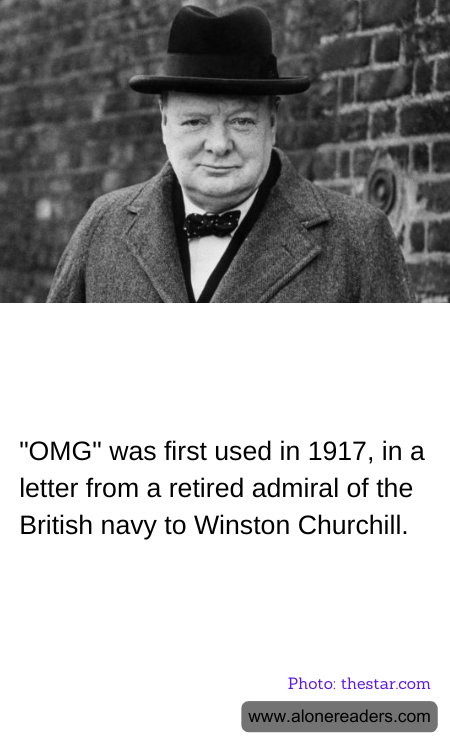
The origins of the acronym "OMG," which stands for “Oh my God,” date back further than many might assume, casting a light on how contemporary-sounding slang has historical roots. In 1917, long before the digital age and the rise of Internet shorthand, "OMG" made its debut in a written correspondence addressed to a significant political figure of the time, Winston Churchill. The letter was penned by Lord John Arbuthnot Fisher, a retired Admiral of the British Navy, who used the expression in a more lighthearted, casual manner. His use of "OMG" in the letter was to express his surprise or exclamation, much like how it's used in text messaging and social media today.
This instance is a fascinating glimpse into the early adaptability of language and how expressions evolve and adapt over time. Specifically, it suggests that the impulse to use abbreviations for common phrases is not a new phenomenon brought on solely by the digital communication era, but rather a natural linguistic tendency that can appear in any form of communication when brevity or levity is required. The emergence of "OMG" in such a formal context during the early 20th century highlights the playful human element even within structured or serious forms of communication.
Today, "OMG" is ubiquitous across various digital platforms, evolving from a surprising note in a historic letter to a staple in everyday internet parlance. Its usage exemplifies how language not only evolves but also recycles and renews itself across different mediums and epochs. The fact that such a modern-seeming term was used over a century ago reminds us of the timeless nature of expressive language in capturing human emotions succinctly, regardless of the platform or period in history.
