More About This Card
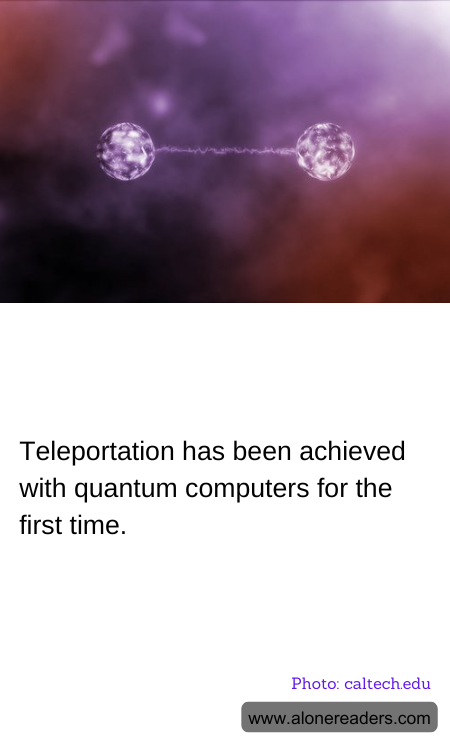
In an unprecedented scientific breakthrough, researchers have successfully achieved teleportation using quantum computers, marking a significant milestone in the field of quantum physics and information technology. This remarkable feat was accomplished by leveraging the principles of quantum entanglement, where particles become interconnected and the state of one instantly influences the state of another, regardless of the distance separating them.
This discovery opens up new avenues for quantum computing and cryptography. Unlike traditional digital computing, which uses bits as the smallest unit of data, quantum computing uses quantum bits or qubits. These qubits can exist in multiple states simultaneously, providing unprecedented processing power for complex computations. The successful teleportation experiment involved transferring quantum information, including the state and identity of qubits, across a quantum computer network without moving the physical particles themselves.
The implications of this technology are immense, especially in the realm of secure communications. Quantum teleportation could potentially enable highly secure communication channels that are immune to eavesdropping. This is because the quantum information, such as encryption keys, could be shared instantaneously and securely across vast distances without ever traveling through the intervening space. Any attempt at interception would, due to the nature of quantum mechanics, disrupt the state of the entangled particles and be immediately evident.
Further applications of this technology could revolutionize various sectors including cybersecurity, data centers, and even fundamental sciences. For instance, quantum networks could form the backbone of future quantum internet, which would utilize the principles of quantum mechanics to provide a new level of data security and connectivity.
However, despite this significant scientific achievement, practical and widespread application of quantum teleportation remains a challenge. Current quantum computers are still at an embryonic stage and are prone to errors and instability. Moreover, maintaining quantum entanglement over long distances requires extremely precise conditions, as environmental interference can easily disrupt the entangled state.
In conclusion, the successful teleportation of quantum information using quantum computers signifies a pivotal advance, potentially heralding a new era in computing and communications technology. As researchers continue to refine this technology and overcome present limitations, we may soon witness the integration of quantum teleportation into everyday technologies, transforming how we process information and communicate.