More About This Card
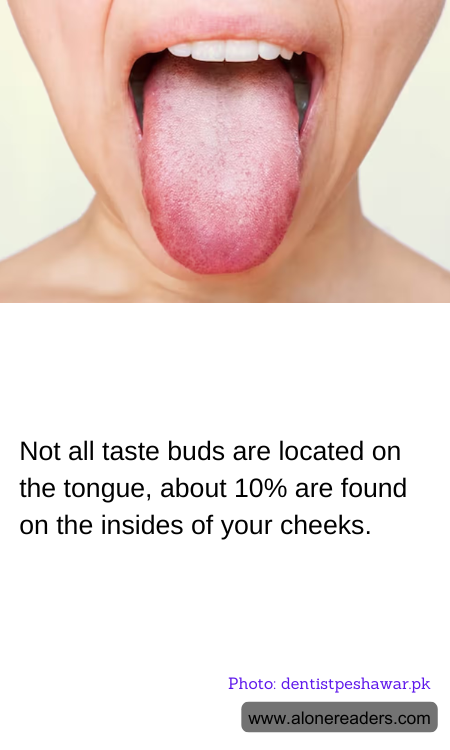
The human gustatory system is a fascinating and complex mechanism far more expansive than many might realize. Often it's assumed that taste buds reside solely on the tongue, but this is a common misconception. In reality, about 10% of our taste buds are not on the tongue but are instead located along the insides of the cheeks, as well as on the soft palate, the upper esophagus, and the epiglottis. This broader distribution of taste buds allows impacts the way flavors are experienced and processed, contributing to a more nuanced perception of taste.
These taste buds, like those on the tongue, contain the taste receptor cells, which are clumped together in formations known as taste papillae. Each taste bud contains 50 to 100 taste cells, and it's these cells that react to different chemicals in our food, sending signals to our brain. The taste buds on the cheeks function similarly to those on the tongue, helping to detect the five elements of taste perception: sweetness, sourness, saltiness, bitterness, and umami.
The presence of taste receptors in the cheeks can also play a significant role in how quickly flavors are perceived. Since these receptors are located closer to the back of the mouth, they may trigger the perception of certain flavors as soon as the food is chewed, enhancing the overall taste experience. This distribution is not just a random scattering but a well-coordinated arrangement that allows humans to have a complex palate.
The extended presence of taste buds beyond the tongue is particularly significant from an evolutionary perspective. It suggests that tasting mechanisms have developed not just for pleasure, but for survival, enabling our ancestors to detect harmful substances before ingestion. Today, this complex system not only guides dietary choices but also influences cuisine and culinary arts. Understanding the role and location of taste buds, including those in the cheeks, can therefore deepen appreciation for the human experience of taste and the dietary behaviors it informs.