More About This Card
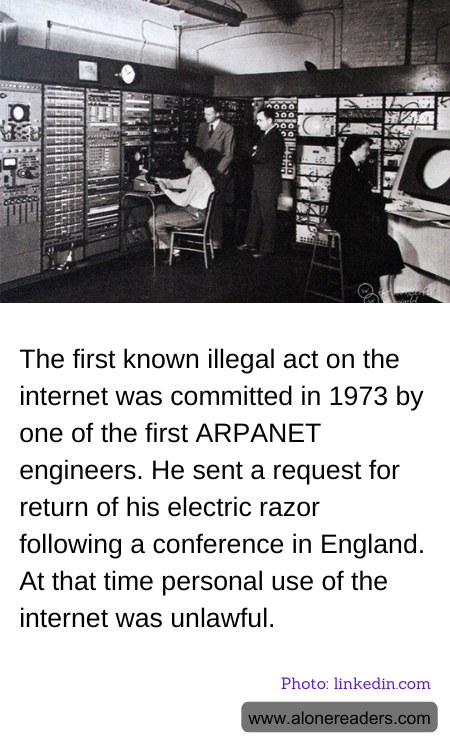
The internet as we know it today was once a fledgling network of interconnected computers known as the ARPANET, designed to support research and communication within academic and military environments. In its early developmental stages, the ARPANET was strictly regulated in terms of its approved uses. One such regulation was the prohibition of using this network for personal or private communications, a rule that was clearly flouted in one of the first documented instances of unlawful use of the internet.
In 1973, an incident involving an ARPANET engineer highlighted the potential for misuse even at this nascent stage of the internet's development. The engineer, who had attended a conference in England, used the ARPANET to send a message requesting the return of a personal item, an electric razor, that he had left behind. This seemingly innocuous action was, in fact, illegal due to the policies governing the use of ARPANET at the time, which declared that the network was to be strictly used for governmental and officially sanctioned research purposes only.
This episode is significant not only because it marks one of the first instances of internet misuse but also because it underscores the challenges of regulating a new and rapidly evolving technology. As the ARPANET expanded and eventually evolved into the modern internet, personal use became not only accepted but also one of the primary driving forces behind the network's exponential growth. What began as a restricted, government-funded project has transformed into a global platform for communication, commerce, and entertainment.
The case of the engineer and his electric razor serves as a quaint footnote in the vast history of the internet, illustrating how norms and regulations evolve alongside technological advancements. It also serves as a reminder of the ever-present potential for misuse of new technologies, an issue that remains highly relevant as the internet continues to grow and change. This early instance of digital misconduct subtly hinted at the vast array of ethical dilemmas and regulatory challenges that would follow in the ensuing decades as the internet became an integral part of daily life for billions of people around the world.