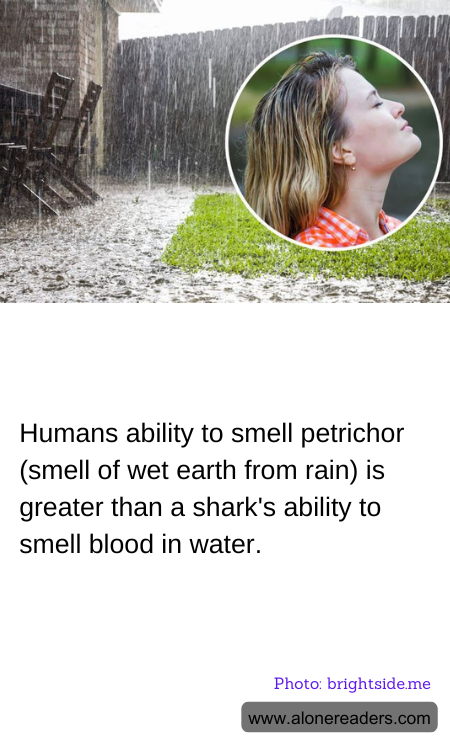
More About This Card
Petrichor, the distinct scent that emerges when rain falls on dry soil, is not only a poetic reminder of nature's cycles but also an intriguing example of human sensory perception. This earthy aroma is produced when a rainstorm releases aromatic compounds like geosmin and petrichoric acid from the soil. Interestingly, research suggests that humans are exquisitely sensitive to the smell of geosmin, one of the primary components of petrichor, able to detect it at concentrations as low as 5 parts per trillion.
This level of sensitivity is fascinating when compared to another oft-cited example of olfactory acuity: the shark’s ability to detect blood in water. Sharks are renowned for their sense of smell, capable of detecting blood at one part per million—a fact that highlights their prowess as predators in the ocean. However, when comparing the sensitivity thresholds, humans can detect geosmin at levels up to 200 times lower than the concentrations at which sharks can smell blood.
It's essential to note that these sensory thresholds have evolved for different reasons. Humans’ acute ability to detect geosmin may have had survival advantages by aiding our ancestors in locating water sources or determining the best times for planting crops. In contrast, a shark's ability to smell blood supports its role as an efficient predator, helping it locate prey over great distances.
Though it may seem surprising, the comparison underscores a broader truth about sensory capabilities: they are often finely tuned to specific ecological or evolutionary needs. While the shark reigns underwater, humans maintain their own remarkable sensory specialization on land. This sensitivity to petrichor not only satiates a biological necessity but also enriches human experiences, tethering us profoundly to the natural world.