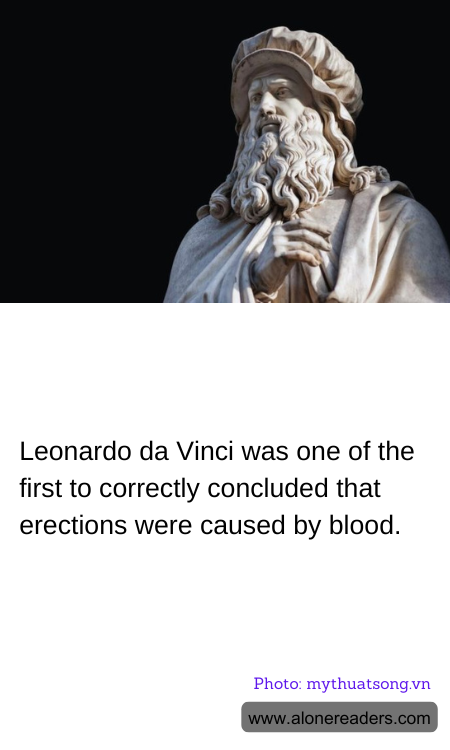
More About This Card
Leonardo da Vinci, the quintessential Renaissance man, was not only a master artist but also an exceptionally keen observer of the human body and natural phenomena. His interests ranged across various fields including anatomy, engineering, and biology, demonstrating a profound connection between art and science. Among his many scientific insights, da Vinci made groundbreaking observations regarding human anatomy, including the mechanics of muscle and bone movement, as well as the function of internal organs.
One of Leonardo's more significant medical insights was his understanding of the circulatory system, particularly his theory about how erections occur. Prior to da Vinci's observations, the common belief, influenced heavily by Galenic teachings, was that erections were caused by air or "vital spirits." Da Vinci challenged this notion through meticulous dissections and study of the male genitalia.
In his detailed anatomical notebooks, da Vinci sketched and described numerous organs, including the penis, with precision. He was perhaps the first to correctly record that erections are caused by the engorgement of blood, not air. He noted that the penis contains a special spongy tissue that fills with blood, not air, during sexual arousal. This was a revolutionary understanding at the time and indicated the beginning of modern vascular and anatomical science.
Leonardo's studies went largely unrecognized for many years, partly because they were not published during his lifetime. His anatomical drawings remained obscure until long after his death, and it wasn’t until centuries later that his contributions to anatomy were truly appreciated. His application of scientific principles to study the form and function of the human body laid the groundwork for future anatomical discoveries and helped to evolve the study of biology and medicine into their modern forms.
His approach was truly ahead of its time and exemplifies his genius in integrating art and scientific inquiry, which allowed him to explore and document the complexities of the human body and various natural phenomena in ways that no one of his era had done before. Leonardo’s observational prowess and meticulous documentation challenge our understanding of Renaissance science and art, positioning him as a key figure in the transition to modern scientific thinking.