More About This Card
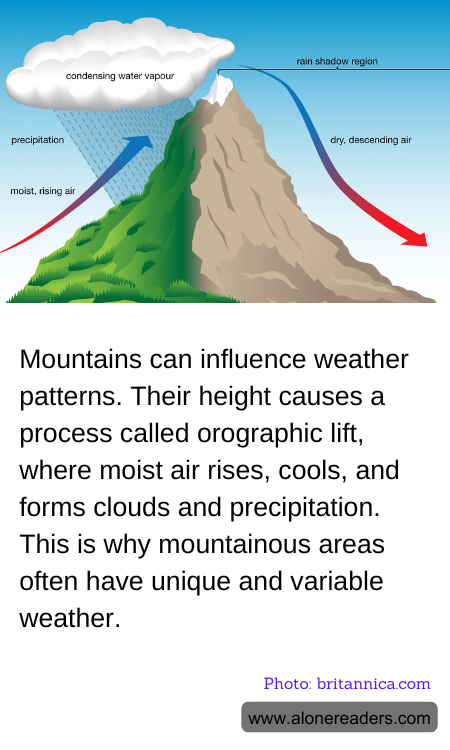
Mountains play a significant role in shaping the climate and weather patterns of surrounding areas, primarily through a process known as orographic lift. When moist air mass encounters a mountain, it is forced upwards along the slope of the mountain into cooler altitudes. This ascent causes the air to cool and expand, leading to condensation and cloud formation. As this process continues, the moisture in the air often precipitates out as rain, snow, or sleet, depending on the temperature.
Due to this phenomenon, regions on the windward side of mountains often receive substantial rainfall and are characterized by lush, green landscapes due to the consistent moisture. In contrast, the leeward side of the mountain, also called the rain shadow area, sees dramatically less precipitation. This is because, having lost much of its moisture on the windward side, the air descends and warms on the leeward side, inhibiting cloud and precipitation formation. This result in much drier conditions, which can significantly affect the flora and fauna as well as the human activities in the area.
Moreover, mountains can also lead to the development of local winds, such as valley and mountain breezes, intensifying the weather variability within mountainous regions. During the day, sunlight heats the valleys faster than the mountains, causing the air to rise from the valley and create a mountain breeze. At night, as the valleys cool, the direction of the wind reverses, creating a valley breeze. These dynamics can further complicate the local weather patterns, making mountainous areas subject to a wide range of changing conditions over short distances and timescales.
Overall, the impact of mountains on weather is complex and multifaceted, leading to diverse microclimates in the regions they dominate. These effects are not only of academic interest but also have practical implications for agriculture, water resources management, and disaster preparedness in mountainous regions.