More About This Card
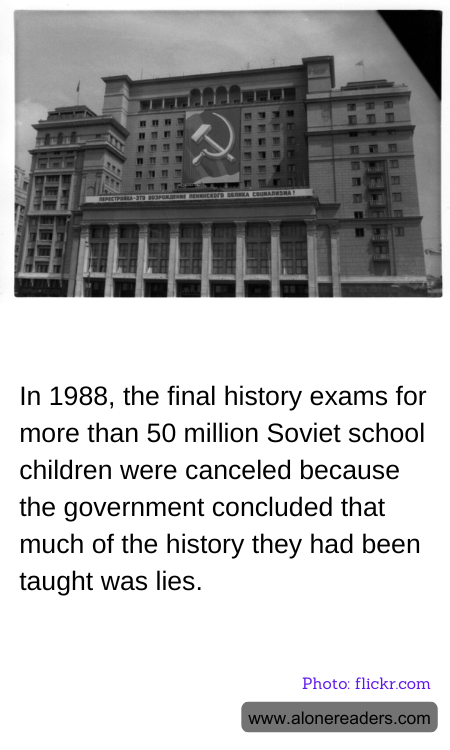
In 1988, a groundbreaking decision was made by the Soviet government that affected over 50 million schoolchildren: the cancellation of final history exams. This decision was not due to administrative or organizational issues but rather a striking admission by the authorities that the historical education imparted to these students was fundamentally flawed and filled with distortions. For decades, Soviet educational curricula were tightly controlled by the Communist Party, which used history lessons as a tool for propaganda to promote its ideology and justify its actions.
The recognition of this flawed educational practice came in the backdrop of Mikhail Gorbachev's policies of Glasnost (openness) and Perestroika (restructuring), which were aimed at increasing transparency in the government and reforming the Soviet political and economic systems. Glasnost encouraged a new level of openness in discussing societal problems, historical truths, and the mistakes of past leaders, many of whom were glorified in school textbooks. The admission that history had been manipulated in educational texts was a momentous acknowledgment that previous regimes had often rewritten or obscured historical facts to suit their purposes.
This decision had significant ramifications. For one, it underscored the necessity for a major overhaul of the Soviet educational system and curricula, particularly in the teaching of history, which had to be rewritten to reflect a more accurate and balanced perspective. It also evidenced the government's commitment to rectifying past wrongs and fostering a more informed and critical generation.
More broadly, the cancellation of the history exams was symbolic of the shifting ideological frameworks within the Soviet Union at the time. It reflected an increasing dissatisfaction with the old regime's ways and an eagerness among the public and within certain government factions to set a new course that was more reflective of historical truths and less bound by dogmatic manipulation.
Although this decision was specific to the realm of education, its implications were felt across various sectors of Soviet society, paving the way for more profound changes and the eventual dissolution of the Soviet Union itself in 1991. This act of revising the educational narrative contributed critically to the broader movement of reassessing and reforming Soviet identity and governance during a pivotal era in the region's history.