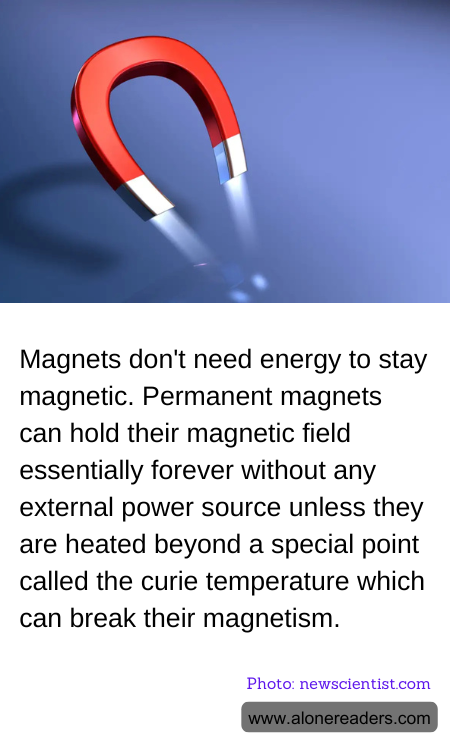
More About This Card
Magnets are intriguing objects, capable of exerting an invisible force that can pull on other ferromagnetic materials or even push them away. What makes them especially remarkable is that permanent magnets, such as those made from materials like iron, nickel, or cobalt, do not require an external energy source to maintain their magnetic properties. This enduring magnetism is due to the alignment of magnetic domains within the material. In an unmagnetized piece, these domains are randomly oriented and cancel each other out. However, when magnetized, these domains are aligned in the same direction, reinforcing each other to create a strong magnetic field.
This magnetic field remains stable under normal conditions and can last indefinitely if the magnet is not subjected to forces that could demagnetize it, such as extreme heat, physical shock, or exposure to a strong opposing magnetic field. The stability of a magnet is notably susceptible to temperatures exceeding the Curie temperature, a critical threshold specific to each magnetic material. At this temperature, the thermal energy becomes sufficient to randomize the orientation of the magnetic domains, effectively causing the material to lose its magnetic properties.
This temperature is named after Pierre Curie, who discovered that magnetism in materials was lost at a critical temperature. The exact Curie temperature can vary widely; for iron, it is around 770°C, while for nickel, it is about 360°C. Beyond reaching the Curie temperature, the loss of magnetism is generally not reversible simply by cooling the material back down. Instead, the material would need to be remagnetized by exposing it to a strong magnetic field.
Despite this vulnerability to high temperatures, the ability of permanent magnets to maintain their magnetism indefinitely without the need for an energy source makes them incredibly useful in a wide variety of applications—from simple refrigerator magnets to complex electric motors and generators. They are a silent yet essential part of many mechanical and electronic processes, providing movement, detection, and attachment capabilities without any ongoing energy costs. This enduring power, coupled with the renewable way they can be magnetized, positions permanent magnets as fundamental components in both everyday items and advanced technological devices.