More About This Card
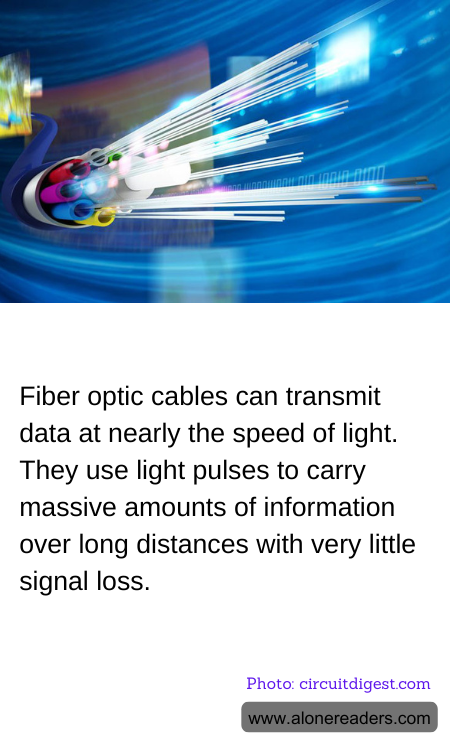
Fiber optic cables, a cornerstone of modern telecommunications, use pulses of light to transmit data at speeds that are close to the speed of light—roughly 300,000 kilometers per second. This technology represents a significant advancement over traditional metal wire transmission, such as copper cables, where the speed and quality of data transmission can be hampered by electromagnetic interference and signal degradation over long distances.
The core of a fiber optic cable is made of glass or plastic fibers, which allow light to travel with minimal loss of signal, permitting data to move with high efficiency and over great distances without the need for frequent signal boosters. This is achieved by a process called total internal reflection wherein light waves are guided down the core of the fiber by bouncing repeatedly off the walls, essentially enabling data to be sent through a pipeline of light. A cladding layer surrounds the core, and its optical properties ensure that the light pulses do not escape and instead keep moving forward within the core, enabling data to transit smoothly and with minimal loss.
Fiber optics have revolutionized various sectors, providing the backbone for internet and telecommunications systems as well as being pivotal in medical instruments, automotive, and aviation industries, among others. The ability to handle the ever-growing demand for bandwidth without compromising on speed makes fiber optic cables especially critical in the era of big data, video streaming services, and cloud computing. Furthermore, fiber optics are less susceptible to adverse weather conditions and electrical interference, making them more reliable than their metallic counterparts.
The transformative impact of fiber optic technology is evident in its applications across different fields. In telecommunications, it facilitates the rapid transmission of internet data, allowing for high-speed broadband services. In medicine, fiber optic technology improves imaging and diagnostic tools, while in industry, it enhances automation and control systems.
Recognizing the benefits and potential of fiber optics, many countries and companies continue to invest in expanding their fiber optic networks to ensure greater connectivity and advance technological innovation. Greater adoption of fiber optics not only supports the expansion of digital networks but also pushes the boundaries of what can be achieved through modern technology.