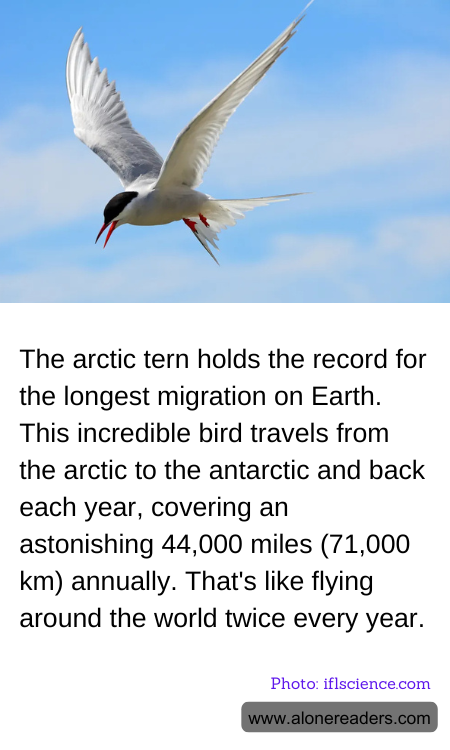
The Arctic tern, a small, seemingly delicate seabird, is known for its remarkable migratory pattern, arguably the longest of any animal on Earth. Each year, this bird embarks on an awe-inspiring journey that spans from its breeding grounds in the Arctic Circle to the Antarctic Circle and back, covering a staggering 44,000 miles. This phenomenal distance is equivalent to nearly twice the circumference of the planet.
The purpose behind such an arduous journey is primarily driven by the tern’s quest for continuous daylight, utilizing the extended hours of sunlight in the polar regions to feed and nurture their young. During this migration, the Arctic tern experiences more daylight than any other living creature on the planet, which is crucial for its survival and breeding success.
The ability of the Arctic tern to navigate across such vast distances also remains a subject of fascination among scientists. It utilizes a combination of celestial cues, Earth’s magnetic field, and perhaps even olfactory cues to find its way. The precision of its navigation is so acute that individual terns often return to the very same nesting spots year after year.
The endurance and resilience of the Arctic tern are even more impressive considering its size and weight, with an average length of about 33-39 cm and a wingspan of around 76-85 cm. This tiny bird faces numerous challenges along its migratory route, including harsh weather conditions, predators, and the need to find sufficient food over vast ocean expanses.
Studying the Arctic tern not only broadens our understanding of migratory patterns in birds but also helps to highlight the impacts of global climate change. Changes in sea temperatures and ice conditions affect the availability of the tiny fish and crustaceans that terns feed on. Observing how the Arctic tern adapts its migratory routes offers valuable insights into ecological balance and the interconnectedness of Earth’s diverse ecosystems. Consequently, the conservation of such species and their habitats becomes crucial, ensuring that the Arctic tern continues to grace our skies with its remarkable annual journey.
