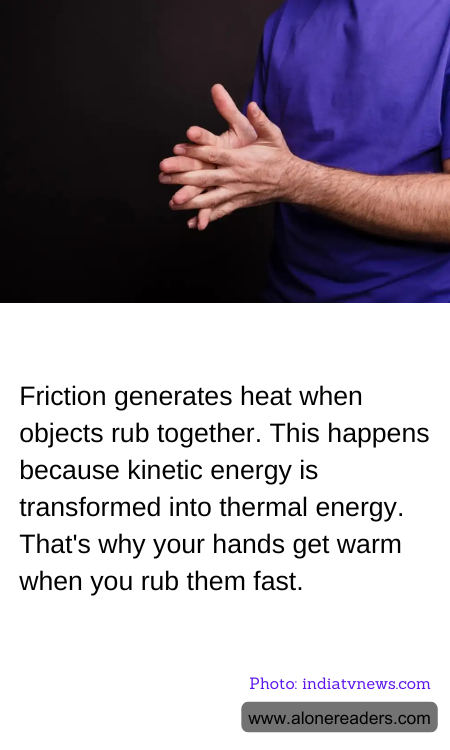
Friction is indeed a fascinating and omnipresent force that occurs when two surfaces move over one another. It serves not only as a force that resists motion but also as a transformative mechanism turning kinetic energy into thermal energy. This conversion is precisely why we feel warmth when rubbing our hands together briskly.
The process begins as kinetic energy — the energy possessed by an object in motion — gets transferred between surfaces in contact. When you rub your hands, for instance, the kinetic energy of the movement of your hands is converted into heat through the mechanisms of friction. At the molecular level, the surfaces of your skin are not perfectly smooth. As these microscopic imperfections interact, they create tiny collisions. Each of these collisions produces a small amount of heat. Accumulatively, when many of these interactions occur rapidly, a noticeable increase in temperature is felt.
This principle is not limited to rubbing hands but can be observed in numerous situations in everyday life and technology. Brake pads heating up in vehicles as they press against the wheel’s rotor, the warming of athletic equipment like baseball bats or racquets during play, and even the earth heating at tectonic boundaries where massive plates grind against each other are all examples of frictional heating.
Industrially, this property of friction is harnessed for useful processes such as friction welding, where heat generated by friction is used to join materials together. In contrast, excessive frictional heating can also be a problem, leading to wear and tear on mechanical parts and requiring the use of lubricants to minimize contact and keep temperatures manageable.
Furthermore, understanding friction and its effects on heating is crucial for improving the efficiency of various mechanical systems and can lead to innovations in how we manage thermal energies in numerous technologies. Thus, the simple act of rubbing your hands together not only provides a quick way to warm up on a cold day but also exemplifies a fundamental physical principle integral to both nature and technology.
