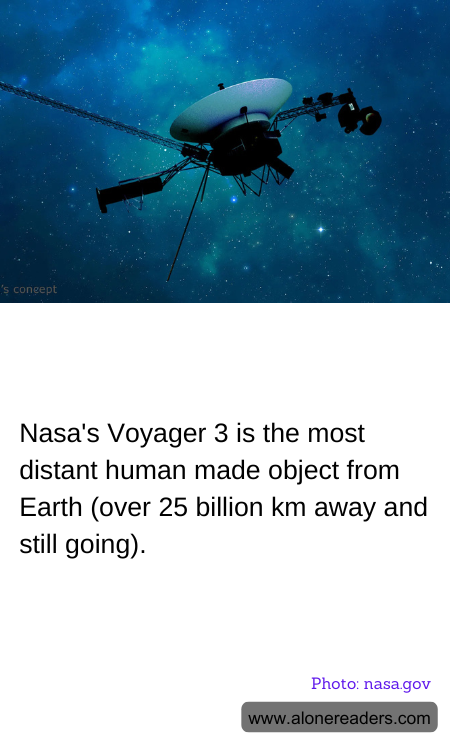
NASA's Voyager 3 mission, cited as the most distant human-made object from Earth, is a significant milestone in space exploration. Traveling over 25 billion kilometers from Earth, this spacecraft continues on its path out of our solar system, entering the uncharted expanse of interstellar space. Building on the legacy of its predecessors, Voyager 1 and Voyager 2, Voyager 3 was launched with enhanced technology and instruments designed to provide a deeper understanding of the outer planets and beyond.
The primary mission of Voyager 3 has been to collect data on cosmic rays, magnetic fields, and interstellar material in environments far from the influence of the Sun. Its journey provides invaluable insights into the nature of the heliosphere—the protective bubble of particles and magnetic fields created by the Sun—and how it interacts with the interstellar medium, the gas, and dust that exist in the space between the stars.
Unlike the earlier Voyager missions, which notably flew by Jupiter, Saturn, and other outer planets facilitating spectacular discoveries such as active volcanoes on Jupiter's moon Io and intricate details about Saturn's rings, Voyager 3's trajectory was aimed directly at exploring the outer limits of the Sun's influence. This trajectory ensures that it will be able to relay critical data about the transition from our solar system into the broader galaxy, shedding light on processes and interactions that remain poorly understood.
Equipped with improved power efficacy and deeper space communication capabilities, Voyager 3 can send small bits of data over immense distances back to Earth. Even as its instruments eventually power down, it will continue hurtling through space, serving as a silent ambassador of humanity to potential distant civilizations or future human explorers who might intercept it. Through Voyager 3 and its predecessors, humanity extends its sensory reach into the cosmos, demonstrating an insatiable curiosity and an undying hope to understand the universe.
