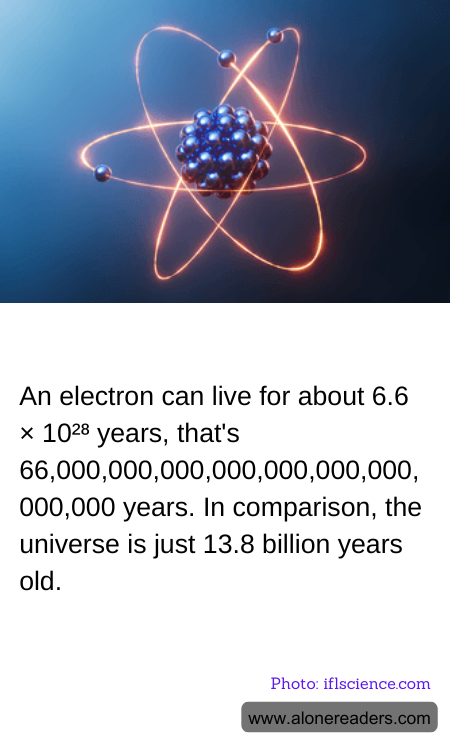
The lifespan of an electron, estimated at approximately 6.6 x 10^28 years, astronomically surpasses the current age of the universe, which is about 13.8 billion years. This incredibly long lifespan of an electron might initially seem perplexing or irrelevant given the vast discrepancy when compared to the temporal scales of human experience or even the age of the cosmos. However, this figure carries significant implications for our understanding of fundamental particles and the stability of matter.
Electrons are elementary particles; they are a fundamental component of atoms and thus play a pivotal role in the structure and behavior of all matter. The stability of electrons is key to the stability of atoms, and by extension, all matter in the universe. The theoretical decay of an electron, projected to occur over such a vast timeframe, would profoundly impact the principles of physical and chemical processes.
Understanding the decay of an electron also ties into the broader field of particle physics, where researchers explore the durability and interactions of elementary particles. The immensely long predicted lifespan of an electron suggests its decay, if it occurs at all, is exceedingly rare and hence has not been observed experimentally. By consequence, electrons are considered stable in practical terms.
From a cosmological perspective, the longevity of electrons also assures the continuous operation of the fundamental laws of physics as we currently understand them, over the timescale of the current universe. Without this stable feature, the consistent structure of atoms over billions of years would be questionable, which would have deep implications for everything from the formation of stars and planets to the existence of life.
The relative infancy of our universe compared to the predicted lifespan of an electron puts into perspective both the robustness and the mystery of the basic building blocks of nature. It invites a humbling reflection on the scales of natural phenomena and our place within the grand timeline of the cosmos. These insights not only deepen our understanding of the material universe but also fuel the continued quest for knowledge within the domains of physics and cosmology.
