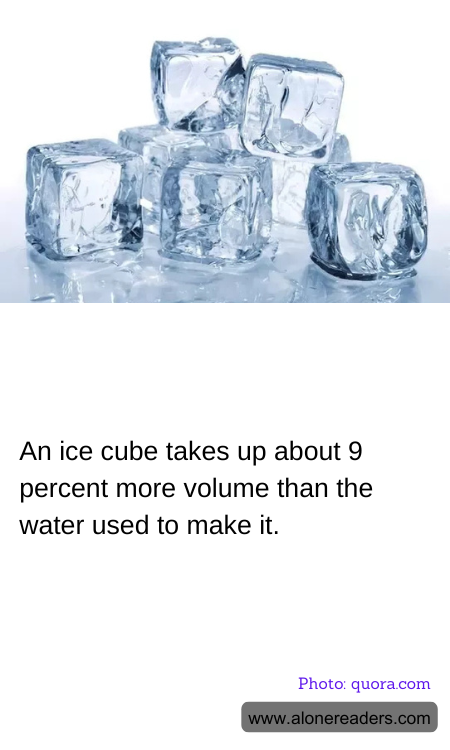
When water freezes into ice, it exhibits a fascinating physical property: it expands and takes up about 9 percent more volume than in its liquid state. This occurs because water reaches its maximum density at around 4 degrees Celsius. As it cools further and freezes, it expands rather than contracts like most other substances. The reason behind this unusual behavior lies in the molecular structure of water.
Water is made up of two hydrogen atoms and one oxygen atom (H2O). When water is liquid, the molecules are relatively free to move about and are only loosely connected by hydrogen bonds. As the temperature drops, these molecules start to slow down and settle into a more structured arrangement. During freezing, water molecules form a crystalline structure known as ice. In this lattice, each oxygen atom is tetrahedrally coordinated to four hydrogen atoms – two by covalent bonds and two by hydrogen bonds. This arrangement makes ice less dense because the molecules are spread out more than in liquid water.
This unusual expansion upon freezing has several implications in everyday life and natural processes. For example, it's why ice floats in water, which is crucial for aquatic life. During winter, bodies of water freeze from the top down, forming an insulating layer of ice that protects the organisms in the water below from freezing. Without this property, lakes and ponds would freeze solid, likely killing all life within them.
Moreover, the expansion of water as it freezes can cause pipes to burst in homes during cold weather. The water inside pipes can freeze, expand, and increase the internal pressure enough to rupture the pipe. Municipal water systems and homeowners must take precautions to prevent this, especially in regions where temperatures frequently drop below the freezing point. This property of water is also harnessed in some practical applications, such as ice blasting, where ice is used to clean surfaces by exploiting its expansion to generate force upon freezing in narrow spaces, effectively dislodging dirt and debris.
Overall, the 9 percent expansion of water when it freezes is a peculiar characteristic arising from the unique molecular structure of water. This property has profound effects on the natural world and human activities, influencing environmental patterns and engineering practices alike.
