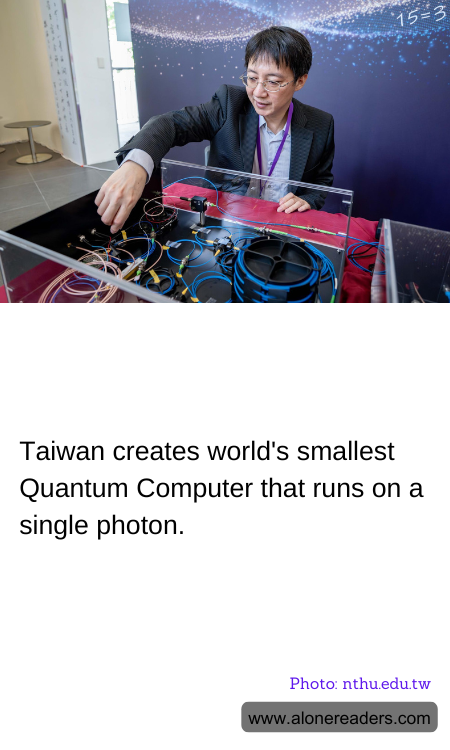
In a groundbreaking development, researchers in Taiwan have successfully created the world's smallest quantum computer, which remarkably operates on a single photon. This compact yet powerful quantum computer represents a significant leap in the field of quantum computing, providing new pathways for technology that is both more accessible and less resource-intensive.
Traditional quantum computers, known for their potential to solve complex problems much faster than classical computers, typically operate on systems requiring multiple qubits. These qubits are usually in the form of charged atoms or optical circuits. However, the Taiwanese innovation pivots away from these norms by utilizing a single photon to act as the quantum bit (qubit), the fundamental unit of quantum information. This miniaturization of quantum technology not only reduces the size and energy requirements of the quantum computer but also poses a scalable model for future developments.
The functioning principle of this photon-based quantum computer revolves around quantum superposition and entanglement, fundamental aspects of quantum mechanics that allow particles to exist in multiple states simultaneously and to interact instantaneously even across large distances. The ability of a single photon to exhibit multiple states is harnessed through precise manipulations using high-level optical techniques, allowing the execution of quantum algorithms at extraordinarily fast rates.
This innovation could catalyze a shift in how quantum computing is integrated into various industries, including cybersecurity, where the power of quantum computing could potentially crack complex encryption codes that are currently considered secure. The pharmaceutical industry could also benefit, as quantum computing could markedly speed up the drug discovery process by efficiently simulating molecular structures. Moreover, because of its reduced size and energy needs, this new technology could facilitate the integration of quantum computing capabilities into more mainstream technology products, potentially even mobile devices in the long term.
Aside from practical applications, the creation of a quantum computer that runs on a single photon opens intriguing theoretical avenues in the study of quantum mechanics itself. It offers a unique platform for testing quantum theories and could lead to a better understanding of the underlying principles governing quantum phenomena.
As the global race in quantum computing heats up, Taiwan’s contribution underscores not only a technical achievement but also a strategic foothold in the evolving landscape of global technology. As advancements continue, the focus on sustainable and scalable quantum computing solutions like the one developed by the Taiwanese researchers could very well define the future of the industry.
