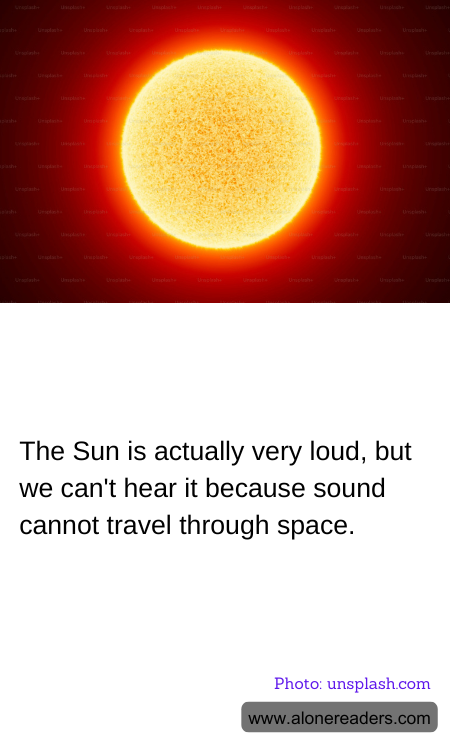
The Sun, the central star of our solar system, is an incredibly loud celestial body. If sound could travel through the vacuum of space, it would reach us on Earth as a deafening roar rather than a gentle sunlight. The Sun produces an immense amount of energy through nuclear fusion at its core, where hydrogen atoms combine under extreme pressure and temperature to form helium, releasing energy in the process. This energy moves outward to the Sun's surface, causing intense vibrations or oscillations that generate sound waves.
These sound waves are tremendously powerful. Scientific estimates suggest that the Sun's surface noise reaches approximately 100 decibels, a level akin to standing near a running motorcycle, making it exceedingly loud. However, since space is a vacuum and lacks any medium like air or water for sound waves to travel through, these waves cannot propagate through space. Sound waves need molecular collisions to travel, and in the absence of molecules in the vast emptiness of space, the sound of the Sun remains confined to its immediate surroundings.
This silence of space is why we experience the Sun solely through its light and heat, rather than sound. The energy from the Sun travels to Earth as electromagnetic radiation, including visible light, ultraviolet light, and infrared radiation, but no acoustic information makes that journey. It is fascinating to imagine what our perception of the Sun might be like if sound could travel through space. It underscores the importance of the Sun’s role in the solar system and highlights the fascinating contrasts between our sensory experiences of astronomical phenomena.
