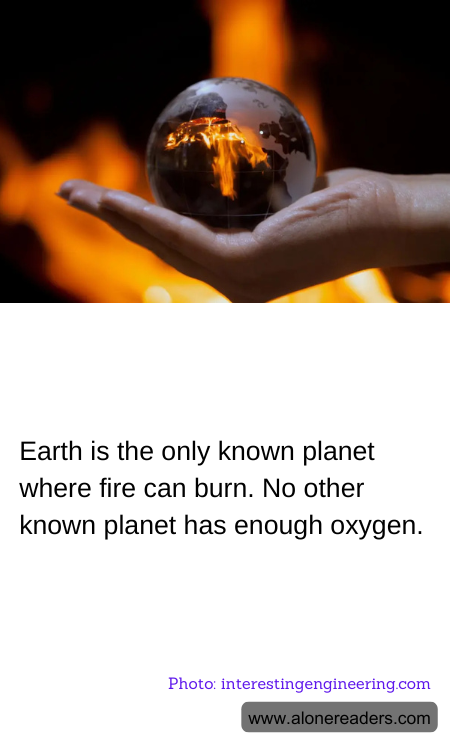
Fire, as we commonly understand it, is a process called combustion, which requires three main components: heat, fuel, and an oxidizing agent (usually oxygen). The uniqueness of Earth in this context lies in its atmosphere, which contains about 21% oxygen, a level suitable to support combustion. This makes Earth distinct as the only known planet in our solar system where fire can naturally occur and sustain itself.
The presence of oxygen in Earth's atmosphere is primarily the result of photosynthesis by plants and certain microorganisms, which over millions of years have altered the atmosphere from one rich in carbon dioxide (like those of Venus and Mars) to one rich in oxygen. This bio-driven process has not only shaped the composition of our atmosphere but also supported the development of complex life.
On other planets, such as Mars, the atmosphere is mostly carbon dioxide with very little oxygen (around 0.13-0.14%), making it nearly impossible for fire to burn as it does on Earth. Venus, similarly, has an atmosphere consisting almost entirely of carbon dioxide with clouds of sulfuric acid, lacking the necessary conditions for fire. The gas giants—Jupiter, Saturn, Uranus, and Neptune—have atmospheres dominated by hydrogen and helium, which are environments unsuitable for the type of oxidative combustion seen on Earth.
Thus, in our exploration of other bodies in the solar system, one of the striking revelations has been the rare and special conditions required on a planet for fire to exist. This fact highlights not only the singularity of our planet in its ability to support fire but also intricate ecosystems and a delicate balance that supports the life forms populating it. The interdependence between life and the phenomenon of fire is a testament to Earth's uniqueness in the cosmos.
