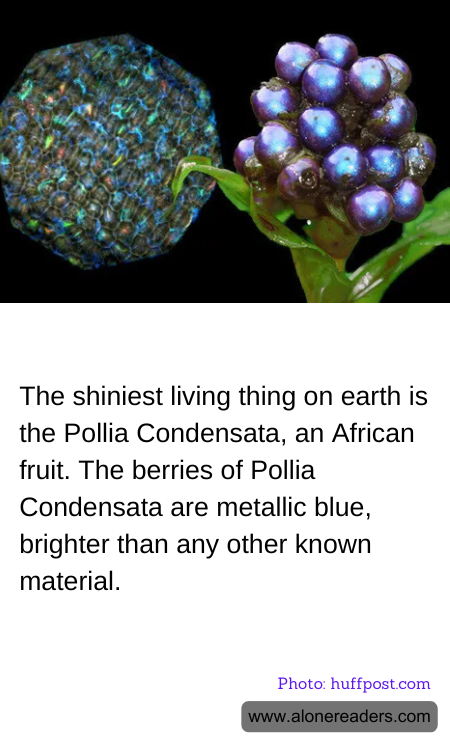
The Pollia condensata, commonly known as the marble berry, stands out in the natural world as the shiniest living thing on Earth. Found primarily in the forests of Africa, this remarkable fruit dazzles with its vibrant, metallic blue hue, which surpasses any other biological material in terms of brightness and intensity. Interestingly, the fruit’s brilliant color is not a result of pigmentation as one might expect, but rather it comes from structural coloration – an optical effect achieved through the fruit's microscopic physical structure.
The surface of the Pollia condensata berry is composed of layers of cellulose fibers that reflect light in such a way that it intensifies the blue coloration. Unlike pigments, which can fade over time, the structural coloration of the marble berry does not lose its luster, allowing the fruit to maintain its brilliance long after it has fallen from the plant. This characteristic makes it not only a marvel of nature but also a subject of interest among scientists and technologists who see potential applications for similar non-fading color in sustainable textiles and other materials.
Despite its eye-catching appearance, the fruit of the Pollia condensata plant is not edible. It contains virtually no nutritional value; its primary role in the ecosystem, aside from reproducing, seems to be attracting birds with its shiny exterior. The birds are drawn to the fruit’s sparkle, eat the berries, and subsequently disperse the seeds, assisting in the reproduction of the plant. This relationship is a prime example of how beauty and functionality are often intertwined in nature, providing essential survival benefits to a species.
The study of Pollia condensata also contributes to the broader field of biomimicry, where biological designs are emulated in engineering and technology. Researchers are particularly interested in how the fruit’s structural coloration can be replicated in materials that are both visually appealing and environmentally friendly, paving the way for innovations in displays, coatings, and textiles without the use of chemical dyes that may be harmful to the environment. Thus, this shiny little berry could soon inspire new, sustainable technologies that make our world not only more colorful but also more eco-conscious.
