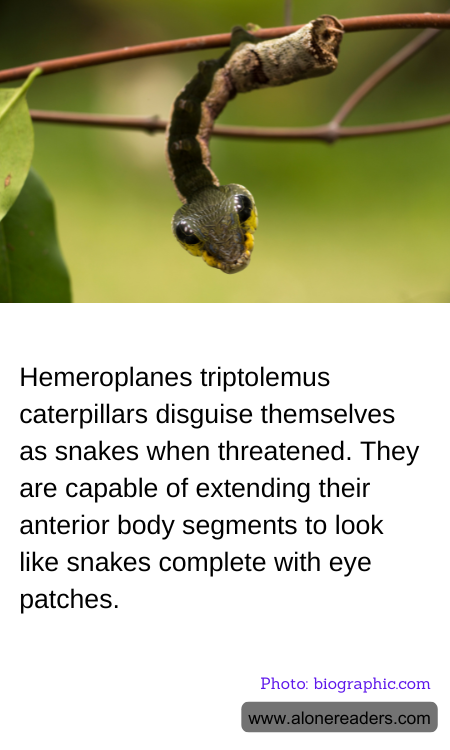
Hemeroplanes triptolemus, a species of sphinx moth caterpillar found primarily in Central and South America, exhibits one of nature’s most dramatic examples of mimicry for survival. When threatened, these caterpillars can perform a remarkable transformation to resemble a snake, a ruse meant to deter predators and ensure their survival into adulthood.
This caterpillar specifically has developed the ability to expand and contort its anterior (front) body segments when disturbed, forming a shape that mimics the head of a snake. The transformation is complemented by eye spots which appear on the swollen part of its body, enhancing the snake-like appearance. These eye spots are not merely simple colorations; they are detailed enough to include what looks like a glare, mimicking the shiny eyes of a real snake, thus adding to the effectiveness of their disguise.
The clever mimicry does not end with visual deception. Hemeroplanes triptolemus caterpillars also move in a manner that enhances their snake-like appearance, swaying from side to side and even striking at threats in a manner similar to how a snake would attack. This behavior can be convincingly realistic, often enough to scare away not just casual predators but even humans who might stumble upon them.
Such an elaborate form of mimicry is a testament to the evolutionary arms race between predators and prey. By pretending to be snakes, which are generally avoided by many larger animals due to the threat of venom, these caterpillars decrease their chances of being eaten and increase their likelihood of reaching maturity and reproducing. The survival tactic showcases the complexity of evolutionary adaptations and underlines the importance of appearance and behavior in the natural world’s fight for survival.
Biologically, this transformation is supported by underlying muscular and skeletal structures that allow the caterpillar to expand and contract its body segments as needed. Scientists believe that these adaptations have evolved over thousands of years and the mimicry we see today is the result of natural selection favoring caterpillars that can best startle and deter their predators.
Understanding and studying such phenomenal survival strategies in creatures like the Hemeroplanes triptolemus not only fascinates but also provides insights into the ecological interactions and evolutionary processes that shape our natural world. These caterpillars serve as a vivid example of how animals adapt to their environments in the most unexpected and ingenious ways.
