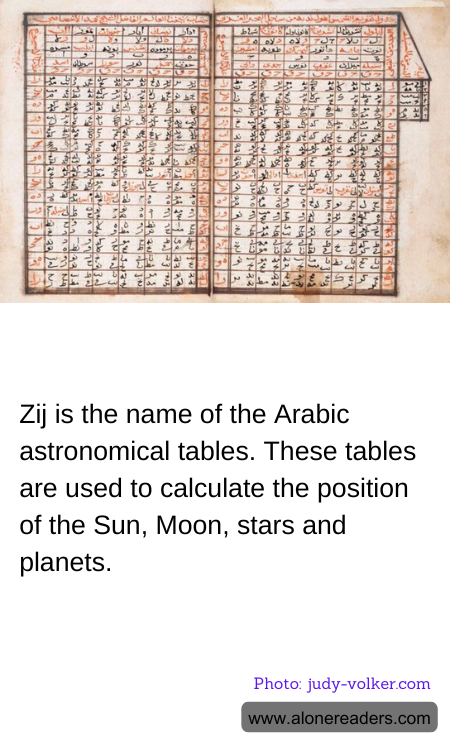
Zij, derived from the Persian word for "cord," refers to the astronomical tables in Islamic astronomy. Created by Muslim scholars during the Islamic Golden Age, these tables were crucial for calculating celestial positions and for various astronomical and astrological purposes. Islamic astronomy flourished from the 8th through the 16th century, during which scholars in the Islamic world made significant advances in observational techniques and astronomical mathematics.
The practice of writing these tables was heavily influenced by earlier works from Indian, Persian, and Greek astronomical traditions, notably the Siddhantas, the works of Ptolemy, and the Persian Shah's tables. Muslim scholars translated these works into Arabic and then expanded upon them, integrating their findings with observations conducted in observatories across the Muslim world, like those in Baghdad, Damascus, and Samarkand.
One of the most famous zijes was the Zij al-Sindhind, based on Indian sources and Ptolemaic teachings, compiled during the reign of the Abbasid Caliph Al-Mansur in the 8th century. Another significant contribution was made by the 9th-century Persian astronomer Al-Khwarizmi, whose zij laid foundations that would later influence both Islamic and European astronomy. His tables incorporated the Hindu concept of sine and used the Arabic names still used for many stars today.
The zijes varied greatly in terms of content and presentation, but they generally included tables for the movements of the sun, moon, and planets, the positions of fixed stars, and often, they covered eclipses and other astronomical phenomena. These tables presupposed a geocentric model of the universe, and they used mathematical procedures to predict the future positions of celestial bodies for calendrical and astrological purposes.
Furthermore, the use of zijes was not restricted to the religious or scientific elite; they also played a crucial role in day-to-day aspects of Muslim community life, such as determining prayer times and the direction of Mecca, as well as in navigating the seas during the Islamic expansion. Their influence extended beyond the Islamic world, playing a significant part in the European Renaissance through the Latin translations made during the 12th century.
The development of zijes underlines the rich history of scientific endeavor in the Islamic world, showing an exquisite blend of inherited knowledge and original contributions, which not only served practical needs but also quenched a deeper thirst for understanding the cosmos.
